
Coryphantha ramillosa
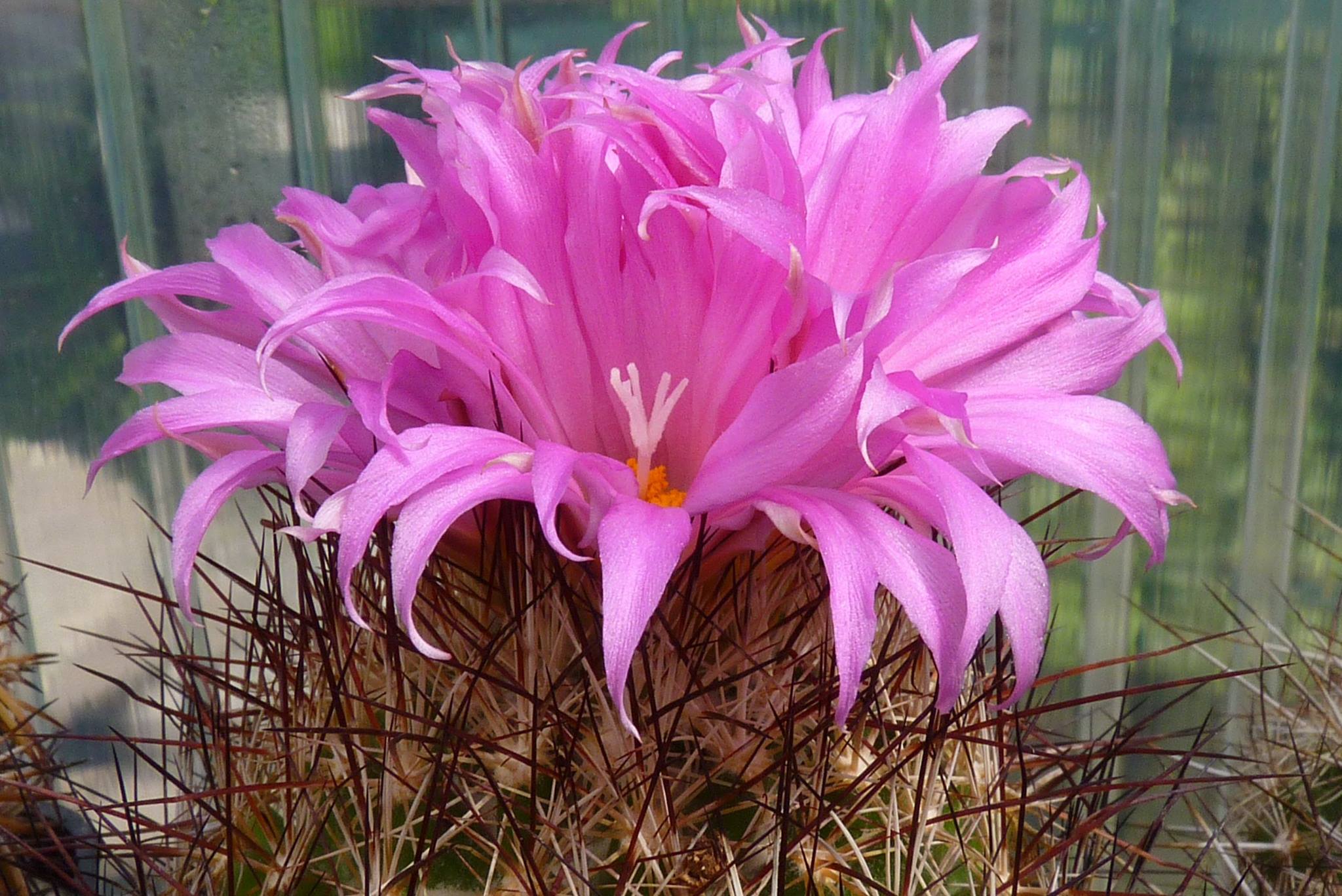
Coryphantha ramillosa Cutak is the bunched cory cactus of the Chihuahuan Desert, a small clumping species first collected by A. R. Davis in 1936 at the head of Reagan Canyon in southeastern Brewster County, Texas. Davis sent material to Ladislaus Cutak at the Missouri Botanical Garden, who formally described the species in 1942 in Cactus and Succulent Journal (US) volume 14, pages 163 and 164. The epithet ramillosa means “small twiggy clusters” and refers to the distinctive bristly halo of twisted radial spines that frames each areole, earning the plant its collector nickname “whiskerbush.”
The species sits between the other Chihuahuan Desert Coryphanthas on this site in terms of conservation profile. Coryphantha werdermannii is the only member of the genus on CITES Appendix I, confined to a handful of limestone hills around Cuatrociénegas. C. ramillosa holds the more common Appendix II status alongside most Coryphanthas, but it carries the additional weight of a US Endangered Species Act Threatened listing that has been in force since November 1979. Three other Coryphanthas carry federal protection in the US: C. minima and C. sneedii var. sneedii as Endangered, and C. sneedii var. leei as Threatened.
The USFWS adopted a two-subspecies treatment in the 2018 Five-Year Review, recognising Dicht and Lüthy’s (2005) C. ramillosa subsp. santarosa for the eastern Coahuilan populations and restricting the federally protected entity to C. ramillosa Cutak subsp. ramillosa, which occupies southern Brewster and Terrell counties in Texas plus adjacent north-central Coahuila. This page covers the autonymic subspecies throughout.
Among the five Coryphantha taxa on this site, C. ramillosa is the only one native to the United States, a distinction that shapes everything from its conservation oversight to the legal path by which collector specimens reach the market. Coryphantha hintoniorum, the compact Nuevo León limestone endemic, and Coryphantha tripugionacantha, Alfred Lau’s Zacatecas discovery, both sit under Mexican federal jurisdiction alone; C. ramillosa must satisfy two national legal systems simultaneously.
Coryphantha ramillosa quick reference
A Chihuahuan Desert cactus confined to Brewster County, Texas and adjacent Coahuila, growing on fractured limestone at 400 to 1,100 m elevation. Values calibrated for seed grown plants in cultivation, drawn from species-specific habitat data and grower records for C. ramillosa rather than genus-level extrapolation. The soil mix is the exception: it is house convention.
Taxonomy & nomenclature
The accepted name is Coryphantha ramillosa Cutak (1942), published in Cactus and Succulent Journal (US) 14: 163–164 based on material collected by A. R. Davis at Reagan Canyon, Brewster County, Texas. The holotype A. R. Davis s.n. (MO #12L12260) is held at the Missouri Botanical Garden herbarium. A date discrepancy runs through the literature: the 1990 Recovery Plan records the Davis collection as 1936, while the 2018 Five-Year Review, citing Cutak (1942) directly, gives 1939. Both dates appear in authority documents and neither has been definitively retracted; the range 1936–1939 is the honest summary.
Del Weniger transferred the species into Mammillaria as M. ramillosa in his 1970 Cacti of the Southwest, but the combination was published without a full and direct reference to the basionym and is invalid under the International Code of Nomenclature. POWO, IPNI, Tropicos, and the Flora of North America all retain Coryphantha ramillosa Cutak as the accepted name.
Dicht and Lüthy (2005) recognised an eastern Coahuilan subspecies, C. ramillosa subsp. santarosa Dicht & A. Lüthy (2000), narrowing the autonymic subsp. ramillosa to southern Brewster and Terrell counties in Texas plus adjacent north-central Coahuila. The USFWS adopted this two-subspecies treatment in the 2018 Five-Year Review and now lists the protected entity as Coryphantha ramillosa Cutak subsp. ramillosa. The species sits in subgenus Coryphantha section Corniferae per Zimmerman’s 1985 systematic dissertation.
Habitat
Coryphantha ramillosa subsp. ramillosa is a Chihuahuan Desert endemic confined to a narrow band along the Rio Grande in southern and southeastern Brewster County and southwestern Terrell County, Texas. Disjunct populations occur across the river in north-central Coahuila, with a marginal record in eastern Chihuahua near the Rio Grande. The species is known from Reagan, Big, Sanderson, Cook, Isinglass, Washboard, Cedar, and Lion canyons, plus a single protected population inside Big Bend National Park near the Rio Grande and a mesa near Seminole Canyon.
Plants grow on highly fractured limestone of the Buda, Boquillas, and Santa Elena formations at elevations from 400 to 1,100 metres. Substrate is the operative factor: the cactus colonises rocky flats, shallow ledges, and open mesa tops where seeds settle into limestone cracks and seedlings establish under the protection of small rocks. Surface pH runs alkaline, typically 7.6 to 8.0, with very low organic content. Associated vegetation is open Chihuahuan Desert scrub dominated by Larrea tridentata, Agave lecheguilla, Fouquieria splendens, and Acacia constricta, with sympatric cacti including Echinocereus stramineus, E. pectinatus, Ariocarpus fissuratus, Echinocactus horizonthalonius, Coryphantha echinus, C. duncanii, and Mammillaria lasiacantha.
The Rio Grande valley receives 200 to 300 millimetres of annual rainfall, most of it in summer convective storms between July and September. Winter lows occasionally drop to −7°C in the Brewster County highlands; cultivated material survives short exposure to those temperatures when the substrate is fully dry. The USFWS provisionally estimates 151,022 hectares of potential habitat across Brewster and Terrell counties, though actual occupancy is patchy across roughly 21 known subpopulations.
Morphology
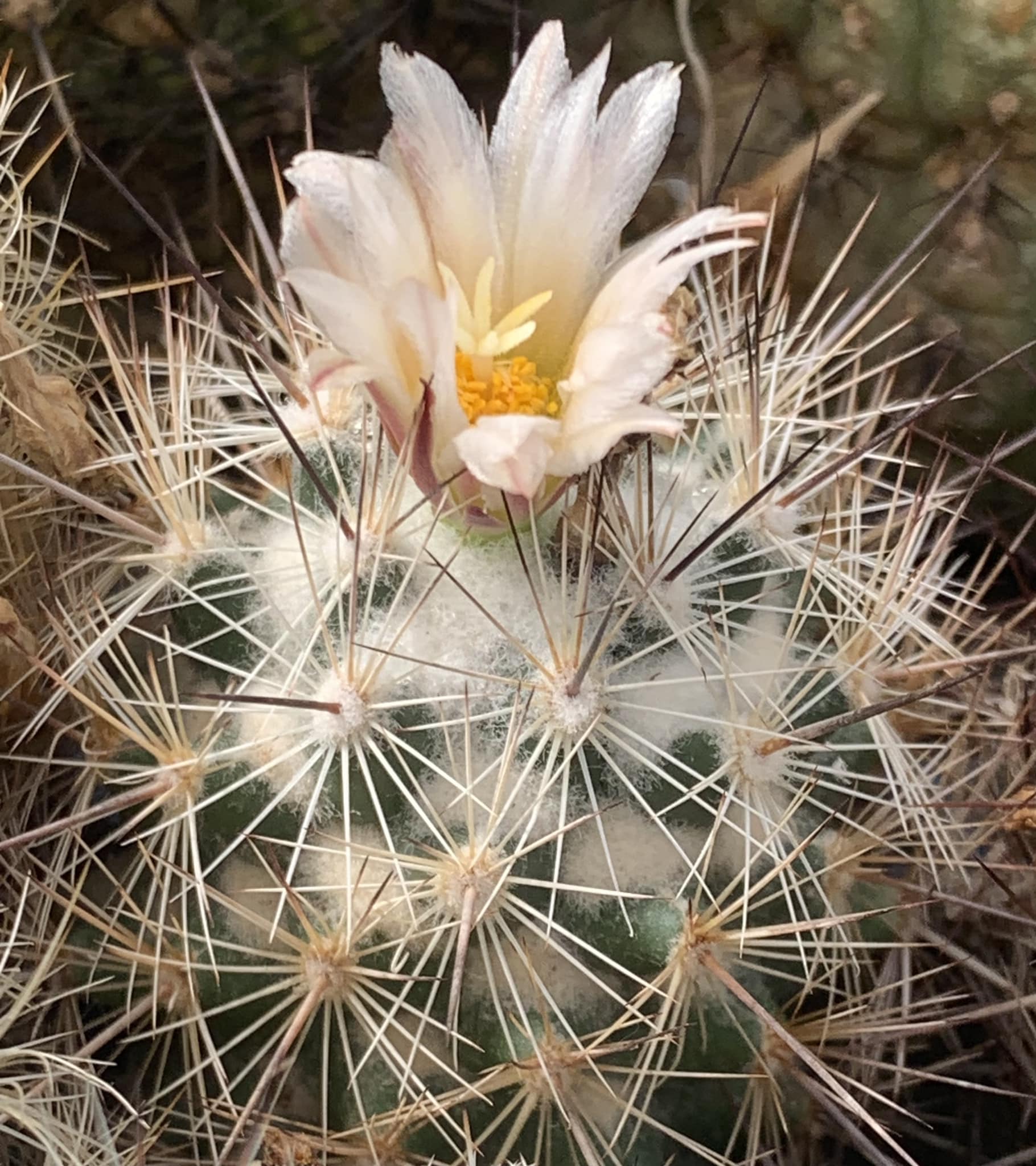
Coryphantha ramillosa is a small clumping cactus that rarely exceeds the size of a tennis ball. Stems are solitary or in groups of a few, globular to depressed-ovoid, 3 to 8 centimetres tall and 6 to 9 centimetres wide, dark grey-green with a wool-capped apex. Tubercles are flattened and overlapping rather than arranged in distinct ribs; each tubercle reaches 2 centimetres in length with a sulcus running from apex to base, the full-length groove diagnostic of the subgenus.
Spination is the character that named the species. Each areole carries 4 central spines 25 to 38 millimetres long, dark brown ageing to grey-brown with darker tips; the lowest central curves downward and the upper three curve upward. Surrounding these are 14 to 20 whitish or grey radial spines 10 to 35 millimetres long, spreading flat and slightly twisted. The combination produces a dense bristly halo that obscures the body when the plant is dry, a diagnostic character separating C. ramillosa from all sympatric congeners.
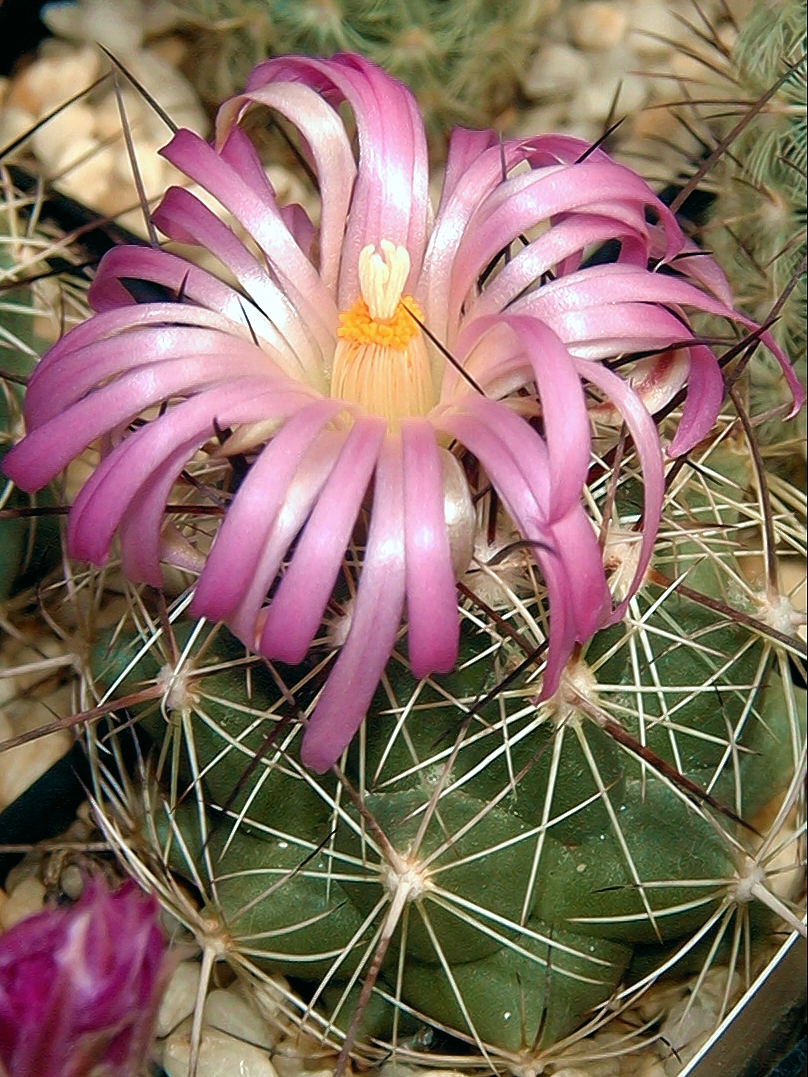
Flowers open from the stem apex in mid-afternoon during the warmest part of the day and last 3 to 14 days. They are 4 to 6.5 centimetres long and 3 to 5 centimetres across, with pale pink to deep rose-purple outer perianth segments carrying a light green or purplish dorsal midstripe; inner segments are paler and broader, with golden-yellow to orange pollen and 6 to 7 white stigma lobes. Pink to purple flowers are unusual within Coryphantha, where most species bloom yellow or cream. The colour is the quickest field cue separating C. ramillosa from sympatric congeners.
Fruits are ovoid, 1.5 to 2.5 centimetres long, dark green to grey-green with white hair-like scales, ripening October through December. The juicy pulp contains around 75 reddish-brown seeds, each 1 to 1.5 millimetres long with a finely reticulate surface. Plants reach reproductive size at 7 to 9 years and 35 to 45 millimetres stem diameter, with wild individuals rarely exceeding 12 to 14 years of age.
Locality detail
The type locality is Reagan Canyon, southeastern Brewster County, Texas, where A. R. Davis first observed the species in 1936. The holotype (A. R. Davis s.n., MO #12L12260) is held at the Missouri Botanical Garden herbarium; Cutak published the description in 1942 from that material. Within Texas the species is additionally documented from Big, Sanderson, Cook, Isinglass, Washboard, Cedar, and Lion canyons, with a protected population inside Big Bend National Park and a site near Seminole Canyon.
Earlier reports of plants at Black Gap Wildlife Management Area were retracted by Schmalzel and colleagues in 1999 when surveys failed to relocate them. The 2018 Five-Year Review provisionally estimates 151,022 hectares of potential habitat across Brewster and Terrell counties, but actual occupancy across the known approximately 21 subpopulations is far more restricted. Precise subpopulation coordinates are redacted on this page following the USFWS and IUCN standard practice for poaching-prone taxa with small, discrete populations; the markers above show regional centroids only.
Coryphantha ramillosa care and cultivation
Coryphantha ramillosa grows wild on the fractured limestone of the Buda, Boquillas, and Santa Elena formations, but no grower record shows it needs limestone in the pot. Winter moisture is the failure mode that accounts for most losses.
Substrate
The correct mix is 30% pumice, 20% lava, 10% zeolite, 15% granite chip, 15% crushed limestone (3–6 mm horticultural grade or oyster shell chip), and 10% worm castings. This ratio delivers the 90% inorganic fraction and the alkaline pH target of 7.5 to 8.5 that mirrors the Santa Elena formation substrate in the field. A tablespoon of dolomitic lime worked into the top centimetre maintains the calcium carbonate buffer between repots. Acidic mixes formulated for South American genera will cause slow decline rather than sudden death; the plant eats through its reserves over two to three seasons before showing visible distress.
The house mix varies across the genus. C. ramillosa and C. hintoniorum carry the same limestone fraction; C. elephantidens carries none. Every limestone share in this table is house convention, not a species requirement.
| Species | Pumice | Lava | Zeolite | Granite | Limestone | Silica | Organic |
|---|---|---|---|---|---|---|---|
| C. werdermannii | 35% | 10% | 20% | 0% | 25% | 0% | 10% |
| C. elephantidens | 30% | 30% | 10% | 20% | 0% | 0% | 10% |
| C. hintoniorum | 35% | 15% | 10% | 15% | 15% | 0% | 10% |
| C. ramillosa (this page) | 30% | 20% | 10% | 15% | 15% | 0% | 10% |
| C. tripugionacantha | 35% | 20% | 10% | 20% | 5% | 0% | 10% |
Watering and light
Water deeply once every 10 to 14 days from May through September, then taper sharply in October. The species is fully dormant from November through February and should receive no water during that window. Late winter dryness is what triggers the spring flush of flower buds; plants kept moist through the cool months will not bloom. Water at the base rather than overhead; the dense spine halo dries slowly and damp spines held against areoles can introduce rot pathways.
Light should be strong but not full noonday sun in hot inland climates during July and August, when 30% shade between 11:00 and 15:00 prevents apex burn on container-grown plants. Coastal and glass-house collections handle direct sun all day. The cold tolerance extends to roughly −7°C provided the substrate is bone-dry, meaning the species can stay in an unheated cold frame in USDA zone 8b and warmer. Wet cold below freezing kills through root rot before the dry-cold floor is reached.
The legal status of this cactus shapes how legitimate stock reaches collectors. Wild collection is prohibited inside Big Bend National Park and on Texas state land; commercial collection from US private ranches requires Texas Parks and Wildlife permits; and any international shipment requires CITES Appendix II documentation confirming nursery propagation. Mesa Garden in Belen, New Mexico, has been the historical primary commercial source for seed-grown material. Desert Botanical Garden in Phoenix maintains a Center for Plant Conservation seed bank with 40 accessions collected between 1988 and 2013.
Propagation from seed is achievable: sow on a fine pumice surface in late spring at 25 to 30°C, mist daily, and expect 60 to 80% germination from fresh seed. Seedlings reach pot-on size in 18 to 24 months and first flowering at 7 to 9 years without grafting. Grafted plants flower 2 to 3 years sooner but lose the compact body shape; most growers keep the species seed grown for the natural form and accept the longer timeline.
Comparison
The closest visual confusable is Coryphantha elephantidens, the showpiece of the genus from Michoacán and Morelos with 6 to 11 centimetre rose-pink to magenta flowers and massive elephant-tusk tubercles. Both species are pink-flowered, setting them apart from most Coryphanthas, but the size differential is enormous: C. elephantidens reaches 25 centimetres wide, towers over C. ramillosa’s maximum 9 centimetres, and the tubercle size alone distinguishes the two at a glance.
Within the Brewster County community where C. ramillosa grows, the nearest identification challenge comes from Coryphantha echinus, which shares the rocky limestone habitat of southern Brewster County but is consistently yellow-flowered with paler grey radials forming a pectinate fan rather than the twisted whisker mass of C. ramillosa. Coryphantha duncanii has shorter paler central spines and pale yellow flowers, while C. sneedii forms tighter columnar clumps and likewise blooms yellow. When C. ramillosa is in flower, the pink to rose-purple colour settles the comparison without further examination.
Escobaria tuberculosa, E. dasyacantha, and E. emskoetteriana share habitat across the Big Bend canyons. All three form denser clusters of cylindrical stems, lack the apex-to-base sulcus on each tubercle that identifies Coryphantha, and have more delicate radials with bloom diameter rarely exceeding 3 centimetres against C. ramillosa’s 5 centimetre spread. Mammillaria heyderi var. meiacantha grows on the same limestone flats but has paired spines, milky sap from cut tubercles, and tiny cream flowers in a ring rather than a single apical bloom.
Frequently asked questions
Is Coryphantha ramillosa hard to grow?
Intermediate. The house mix targets pH 7.5 to 8.5 through a crushed-limestone supplement and dolomitic lime, applied as house convention rather than a species requirement. Beyond the substrate, the species rewards the standard summer-active, winter-dry Chihuahuan Desert routine: deep watering every 10 to 14 days May through September, bone-dry November through February. The dry winter rest is what triggers flower bud set the following spring.
Can Coryphantha ramillosa be grown from seed?
Yes, and seed grown nursery stock is the only legally defensible source for this species in the United States. US ESA Threatened status prohibits the take or commerce of wild-collected plants; Texas state law independently prohibits removal from public land; and CITES Appendix II documentation requires proof of nursery propagation for any international shipment. Sow fresh seed on a fine pumice surface at 25 to 30°C in late spring; germination runs 60 to 80% from fresh seed and occurs within two weeks under good conditions. Seedlings reach pot-on size in 18 to 24 months and first flowering at 7 to 9 years without grafting. Mesa Garden in Belen, New Mexico, has historically been the primary commercial source for documented seed-grown material.
Is Coryphantha ramillosa legal to own?
Legal to own if the plant comes with documented nursery provenance, but the compliance burden is the heaviest of any Coryphantha in cultivation. The species carries four simultaneous legal protections: (1) US Endangered Species Act Threatened listing since November 6, 1979 (44 FR 64247–64250), which prohibits taking or interstate commerce of wild-collected plants; (2) Texas state Threatened status since April 29, 1983, requiring a Texas Parks and Wildlife permit for any commercial collection from private land and prohibiting removal from public land; (3) CITES Appendix II current status, meaning international commercial trade requires an export permit from the country of origin and, where applicable, an import permit confirming nursery propagation; and (4) Mexico’s NOM-059-SEMARNAT-2010, which lists the species as Amenazada (Threatened, category A) in the Diario Oficial. A historical note: the species was originally placed on CITES Appendix I on July 29, 1983, but was later downlisted to Appendix II along with most of the genus. The current CITES status is Appendix II. Plants offered without documentation or with vague provenance should be treated as wild-collected and avoided.
Where does Coryphantha ramillosa grow in the wild?
In the Chihuahuan Desert along a narrow band of the Rio Grande in southern and southeastern Brewster County and southwestern Terrell County, Texas, with disjunct populations across the river in north-central Coahuila, Mexico. Within Texas the species is known from Reagan Canyon (the type locality), Big, Sanderson, Cook, Isinglass, Washboard, Cedar, and Lion canyons, a population inside Big Bend National Park, and a mesa near Seminole Canyon. Approximately 21 subpopulations are known across the range. Plants grow on highly fractured limestone at 400 to 1,100 metres elevation in open Chihuahuan Desert scrub, colonising rocky flats and shallow ledges where seeds settle into limestone cracks.
When does Coryphantha ramillosa flower?
April through August, with timing tied to the summer monsoon. Published sources disagree on the peak window: Weniger (1979) records April to May; Warnock (1970) records June; Heil et al. (1985) record July to August. Schmalzel and colleagues confirmed that bloom and fruit set track monsoon arrival in the Big Bend region, so the full window of April through August represents the span across all conditions rather than a contradiction between sources. Flowers are pale pink to deep rose-purple, 4 to 6.5 centimetres across, opening in mid-afternoon and lasting 3 to 14 days. Pink to purple flowers are unusual within Coryphantha, where yellow and cream are the genus norm, and the colour is the fastest field identification cue separating this species from all sympatric congeners.
Sources & further reading
Cutak, L. (1942). Coryphantha ramillosa, a new species from the Big Bend Region of Texas. Cactus and Succulent Journal (US) 14: 163–164 · US Fish and Wildlife Service (1979). Determination that Coryphantha ramillosa and Neolloydia mariposensis are Threatened Species. Federal Register 44: 64247–64250 (November 6, 1979) · US Fish and Wildlife Service (1990). Bunched Cory Cactus (Coryphantha ramillosa) Recovery Plan. Prepared by K. D. Heil and S. Brack. Region 2, Albuquerque, New Mexico. 49 pp. (Approved April 13, 1990) · Zimmerman, A. D. and B. Parfitt (2004). Coryphantha ramillosa Cutak. In: Flora of North America Editorial Committee, eds. Flora of North America North of Mexico, vol. 4: 225. Oxford University Press, New York · Dicht, R. F. and A. D. Lüthy (2005). Coryphantha: Cacti of Mexico and Southern USA. Springer-Verlag, Berlin. 200 pp. · Anderson, E. F. (2001). The Cactus Family. Timber Press, Portland, Oregon. p. 195 · US Fish and Wildlife Service (2018). Bunched Cory Cactus (Coryphantha ramillosa Cutak ssp. ramillosa) 5-Year Review: Summary and Evaluation. Austin Ecological Services Field Office, Austin, Texas. 36 pp. · Texas Parks and Wildlife Department. Bunched cory cactus. Federal & State Listed Plants of Texas. tpwd.texas.gov · Schmalzel, R., E. F. Anderson, K. Rice, and P. Quirk (1999). Study of the bunched cory cactus (Coryphantha ramillosa Cutak). Final Report, FWS Agreement No. 1448-00002-96-0854. Desert Botanical Garden, Phoenix, Arizona. 63 pp. · Secretaría de Medio Ambiente y Recursos Naturales (2010). Norma Oficial Mexicana NOM-059-SEMARNAT-2010. Diario Oficial de la Federación, December 30, 2010. p. 55 · Heil, K. D. and M. Terry (2013). Coryphantha ramillosa. The IUCN Red List of Threatened Species 2013: e.T151872A581196. iucnredlist.org · POWO. Coryphantha ramillosa Cutak. Plants of the World Online, Royal Botanic Gardens, Kew. urn:lsid:ipni.org:names:66614-2. powo.science.kew.org · CITES. Appendices I, II, and III. Convention on International Trade in Endangered Species of Wild Fauna and Flora. cites.org