
Acharagma
Known Species
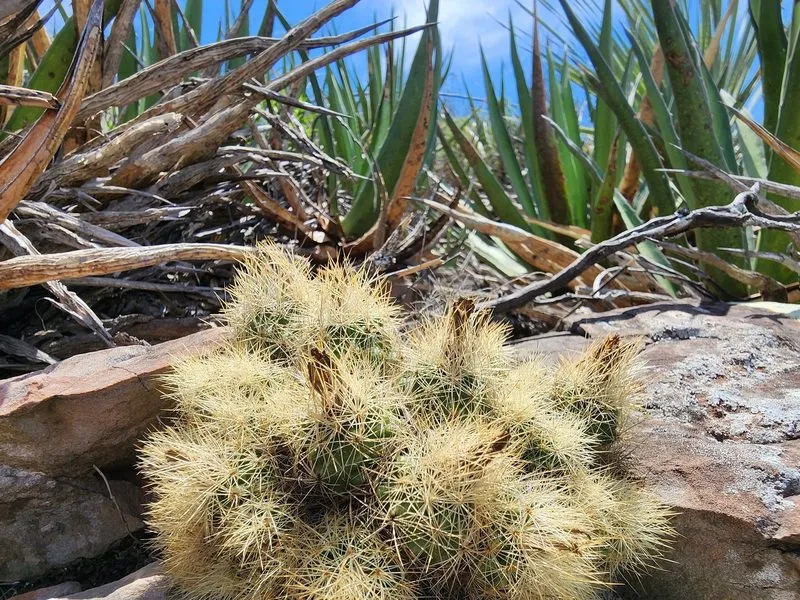


What is Acharagma and how does it differ from Escobaria?
Acharagma is a genus of three miniature cacti endemic to the limestone ranges of Coahuila and Nuevo León in northeastern Mexico. The genus was erected by C.E. Glass in 1997, separating these plants from Escobaria on the basis of their ungrooved tubercles. In Escobaria and Coryphantha, each tubercle carries a shallow adaxial groove running toward the areole; in Acharagma the tubercle surface is smooth and ungrooved. The name itself encodes this character: Greek a- (without) plus charakma (groove). Beyond the tubercle character, Acharagma plants are smaller-bodied than most Escobaria, carry a thick fleshy taproot that penetrates limestone crevices, and are confined to a handful of limestone microhabitats rather than ranging broadly across the Chihuahuan Desert.
Where does Acharagma grow in the wild?
All three species are tight limestone microendemics in northeastern Mexico. A. roseanum occupies rocky scree and calcareous hillsides in southeastern Coahuila and adjacent Nuevo León, growing at 1,100 to 2,100 m in xerophytic shrubland alongside Mammillaria carretii, Astrophytum capricorne, and Echinocereus conglomeratus. A. aguirreanum is confined to Canyon Verde on the western side of the Sierra de la Paila, Coahuila, with an extent of occurrence under 1 km² and a population of fewer than 1,000 individuals. A. galeanense grows near Galeana in Nuevo León at a confirmed collection point of 2,650 m. None of the three species range beyond these specific limestone formations.
How big do Acharagma species get?
Acharagma species are true miniatures, with stems never more than 7 cm across. A. roseanum produces ovoid to subglobose stems 4 to 6 cm tall and 1.5 to 5 cm wide, often clustering to form small groups of 3 to 10 heads. A. aguirreanum stays solitary: globose to depressed-spherical, up to 5 cm tall and 5 to 7 cm across, distinctly wider than tall. A. galeanense grows differently from the other two: its stems are cylindrical and elongating, 6 to 10 cm tall and 2 to 2.5 cm wide, becoming prostrate with age and eventually forming a spreading mat up to 30 cm across. All three species are slow. A clustering adult A. roseanum takes 5 to 10 years to develop from seed.
What do Acharagma flowers look like?
Flowers emerge from the apex of the tubercle axil, funnel-shaped, and 1 to 2 cm across. A. roseanum produces cream to pink flowers with a bronze-rose or reddish midvein; colour varies within populations from near-white to distinct rose. A. aguirreanum flowers are pale cream to yellowish, often with red midstripes on the outer tepals; the 1972 protologue description gives pale pink or pale ivory. A. galeanense is consistently cream-yellow with no pink component, making flower colour a reliable diagnostic between that species and its sister. Flowers are diurnal. Flowering season aligns with the Mexican summer monsoon, typically June through September.
How cold-hardy is Acharagma?
All three species tolerate brief exposure to approximately −7°C (20°F) when the substrate is completely dry. This cold floor is consistent with the mountain limestone habitat: A. roseanum grows at up to 2,100 m in southeastern Coahuila where winters are cold and dry, and the confirmed collection point for A. galeanense sits at 2,650 m near Galeana, where temperatures reach −9°C at town level. The −7°C figure is a reported survival threshold, not a recommended minimum. In cultivation, overwintering above 3 to 5°C while completely dry eliminates any cold risk. Wet cold above freezing is more dangerous to the taproot than dry cold near the survival floor.
What substrate does Acharagma need in cultivation?
All three species grow in rocky calcareous scree. The genus baseline on this site is a 7-component mix: 35% pumice, 15% lava rock, 10% zeolite, 5% granite, 20% crushed limestone, 10% silica, and 5% worm castings, totalling a 95/5 inorganic-to-organic ratio. The limestone fraction is elevated above the Cactaceae baseline as house convention, not as a requirement of any of the three species. Hard tap water already supplies calcium and bicarbonate at every watering; rainwater and RO water supply neither. Growers targeting A. galeanense may raise limestone to 25% under the same convention and reduce or eliminate the organic fraction entirely. The thick taproot is rot-prone: the substrate must drain completely after watering, and the pot must be kept bone-dry from November through March.
Is Acharagma legal to own?
Acharagma falls under the blanket Cactaceae listing on CITES Appendix II. Cross-border movement of plants or seeds requires CITES documentation. Within Mexico, A. roseanum is subject to special protection under NOM-059-SEMARNAT-2010. No US Endangered Species Act listing applies to any Acharagma species. Nursery-propagated plants of documented origin are legal to buy, sell, and grow in the United States, the United Kingdom, the European Union, Canada, and Australia. The legal concern for collectors is provenance: wild-collected specimens are prohibited under CITES, and all three species are under documented illegal collecting pressure.
Why is Acharagma so rare?
The genus is rare at both the biological and practical level. Each species occupies a specific limestone formation with no capacity for range expansion: A. aguirreanum is known from a single canyon with fewer than 1,000 individuals and an extent of occurrence under 1 km². A. galeanense has one confirmed collection area in Nuevo León. A. roseanum has the widest range of the three and is still assessed as Vulnerable by IUCN with an extent of occurrence under 6 km². Illegal collecting pressure is the primary documented threat for A. aguirreanum; overgrazing compounds the pressure on A. roseanum and A. galeanense. In cultivation, all three species are very slow-growing, propagation demand exceeds nursery supply, and locality-verified seed grown specimens command significant prices.
Trace any Acharagma specimen back to its wild origin in our Acharagma field numbers database.