
Lithops karasmontana ‘Top Red’
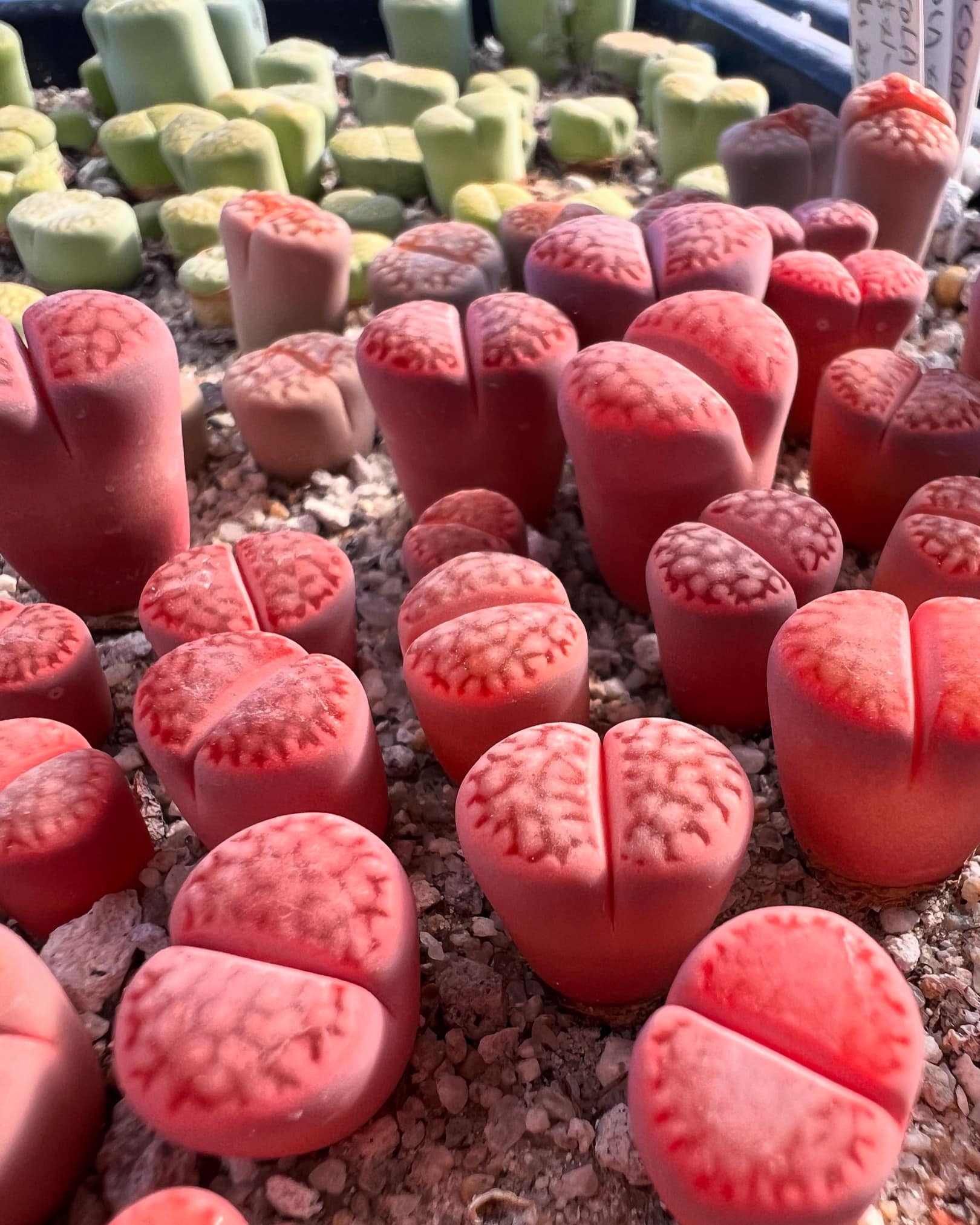
Lithops karasmontana ‘Top Red’ is the trade-defining cultivar of the Karas Mountains living stone, selected for an unusually dense and saturated red channel network etched across the grey-brown dorsal face. Hiroshi Kobayashi formally established the cultivar in 2004 in volume one of Succulents, the monograph series of the International Succulent Institute of Japan, on page 219; the publication was the protologue under the International Code of Nomenclature for Cultivated Plants and is the citation every later seller, monograph, and online encyclopedia traces back to. The photograph in that protologue is credited to Yasuhiko Shimada.
The cultivar sits within Lithops karasmontana, a Namibian endemic of the Great Karas Mountains and surrounding plains around Grünau and Karasburg. Habitat, range, substrate chemistry, dormancy calendar, and cold floor are all shared with the parent species and are covered in detail on the parent page; this page concentrates on what makes the cultivar distinct rather than re-stating the species ecology. The single cultivation parameter where ‘Top Red’ deviates from generic karasmontana is light: the red channel pigmentation is anthocyanin-driven and photolabile, so a plant grown in anything less than full sun loses the colour the cultivar was selected for and reverts visually toward standard wild-type stock.
The trade conflates ‘Top Red’ with var. lateritia, the wild brick-red variety of karasmontana that Dinter described from the same complex. Several nurseries label the same plants as L. karasmontana var. lateritia ‘Top Red’ or use the names interchangeably. Llifle treats the cultivar (entry 17678) and the variety (entry 12170) as separate indexed taxa, and Kew POWO does not formally recognise the var. lateritia at all under its current karasmontana treatment. The position taken on this page is that ‘Top Red’ is the cultivar name per Kobayashi 2004 and is taxonomically distinct from var. lateritia, even if the two are phenotypically close and most modern ‘Top Red’ seed stock descends from lateritia-type parents selected for maximum red saturation.
Among the cultivars and forms on this site, the closest comparisons are the cream-bodied L. karasmontana subsp. bella (opposite end of the colour spectrum within the same species complex) and the geographic subsp. amicorum. Across the broader genus the translucent red L. optica ‘Rubra’ is the other red-saturated Lithops selection in trade and is the visual counterpart to ‘Top Red’ from the opposite (Sperrgebiet coastal) half of the genus range. Care for ‘Top Red’ follows the standard inverted Lithops calendar that runs every page in this genus: active in autumn and winter, dry through summer, the opposite of every cactus on the rest of this site.
Lithops karasmontana ‘Top Red’ quick reference
Care follows the parent Lithops karasmontana profile without modification on substrate, dormancy calendar, or cold floor; the one cultivar-specific note is light. Anthocyanin expression in the red channels is photolabile, so ‘Top Red’ needs full unfiltered sun to look like the cultivar rather than a generic karasmontana selection. Values calibrated for seed grown plants from documented ‘Top Red’ stock; reverting plants on a shaded windowsill are a colour problem, not a health problem.
Taxonomy & nomenclature
Lithops karasmontana ‘Top Red’ is a cultivar name published under the International Code of Nomenclature for Cultivated Plants. Hiroshi Kobayashi established the cultivar formally in 2004 in Succulents volume 1, page 219, the monograph series of the International Succulent Institute of Japan, with a photograph credited to Yasuhiko Shimada. The protologue is the citation every later encyclopedia entry traces to; the original publication has not been directly verified in this build, and the citation rests on two independent secondary references (worldofsucculents.com and cactuspro.com) which may share an upstream source.
The parent species, Lithops karasmontana (Dinter & Schwantes) N.E.Br., was published in Gardeners’ Chronicle Series III, 79: 102 (1926), with the basionym Mesembryanthemum karasmontanum Dinter & Schwantes appearing in Monatsschrift für Kakteenkunde 30: 36 (1920). Kew POWO accepts three infraspecific taxa under karasmontana: subsp. karasmontana, subsp. amicorum, and var. summitatum. POWO does not currently recognise var. lateritia as an accepted infraspecific taxon, although the name persists in the trade and on llifle as a label for the brick-red wild form from which most modern ‘Top Red’ seed stock is derived.
POWO does not list cultivar names; the ICNCP and the specialist Lithops literature are the authorities for ‘Top Red’. Llifle indexes the cultivar separately (entry 17678) from var. lateritia (entry 12170), which is the cleanest evidence in publicly accessible sources that the two are taxonomically distinct rather than synonyms. The trade label ‘L. karasmontana var. lateritia ‘Top Red’’ combines an infraspecific botanical taxon with a cultivar epithet, which is permissible under the ICNCP only where the cultivar was selected from documented var. lateritia stock; the Kobayashi 2004 protologue does not specify the parent variety of the selection. Sibling cultivars within karasmontana include ‘Opalina’ (pale, opalescent face), ‘Lava Flow’ (a hybrid between two varieties), ‘Sunstone’ (a hybrid between subspecies), and ‘Orange Top’ (registered under var. aiaisensis for orange-channel selections).
Habitat
‘Top Red’ is a cultivar; it does not have its own wild range. The parent L. karasmontana is endemic to southern Namibia, with populations clustered around the Great Karas Mountains (Groot Karasberge) and the towns of Grünau, Klein Karas, and Karasburg in the ǁKaras Region. The Karasberg plateau rises above 1,600 m and runs through a winter-rainfall climate envelope with cold, frost-prone winters and hot dry summers. Plants grow on barren quartzite and gravel plains with the body buried flush among the surrounding white-and-grey quartz chips that the dorsal face is mimicking. Annual rainfall in the Karas Region averages around 150–200 mm, concentrated in the cooler months (April–September). Full habitat detail is on the parent L. karasmontana page; this page concentrates on cultivar-specific characters.
The selected stock from which Kobayashi’s 2004 publication established the cultivar is most likely derived from var. lateritia-type populations or from closely related red-channel plants in the same complex. Cole 2005 (the standard Lithops monograph) is the likely source for the parent-stock detail but was not directly consulted for this build; the specific field-collection number that fed the original selection is not documented in any source consulted here.
Morphology
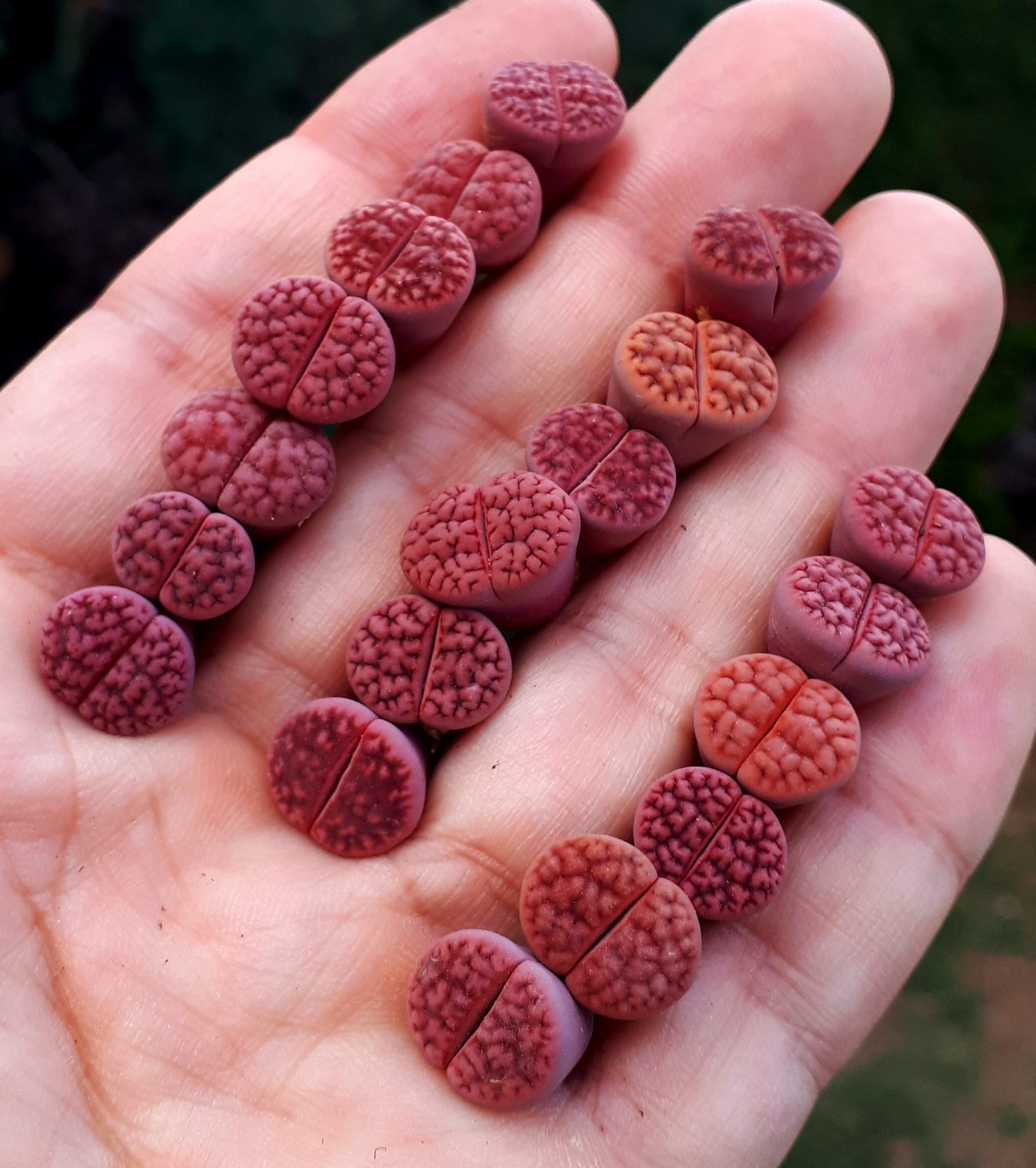
Body form follows the parent species: a single pair of fused, thickened, inverted-cone leaves growing to roughly 4 cm tall, buried flush with the substrate so only the dorsal face is exposed. The faces are semi-elliptical to kidney-shaped, approximately 25–35 mm long by 20–28 mm broad, with a slightly rugose surface texture and a moderately deep central fissure that runs across the face between the paired leaves. Mature plants form clumps of multiple heads over time. These dimensions match generic karasmontana; the cultivar selection criterion is colour, not size.
The diagnostic feature is the dorsal face colour. The base ground colour is grey to grey-brown, providing a neutral background against which the channelled lines stand out. The channels themselves form a dense, well-defined network of brick-red to bright rusty-red marks, with the network covering most of the face and the colour saturation visibly higher than in unselected stock. The Wikipedia description of the cultivar reads “plants with a bright red network of channels”, a brief but morphologically precise summary. What separates ‘Top Red’ from generic karasmontana is the reliability and intensity of the red, not its presence: wild-type karasmontana ranges through grey, brown-green, and red-brown channel colours, sometimes (per llifle) with “rubrications absent” entirely. The cultivar selects for the maximum red expression across virtually all seedlings from the line.
What separates ‘Top Red’ from var. lateritia, the closely related wild form: var. lateritia tends toward a homogeneous brick-red flush across the entire dorsal face, with the window area coloured similarly to the body. ‘Top Red’ tends instead to a cleaner red-channel network against a grey body, where the channel lines are the red element rather than a flush across the whole face. In practice the two are phenotypically close, and the trade conflation reflects a real morphological similarity. Windows in karasmontana are obscure to absent or appear as greyish to bluish semi-translucent zones; the cultivar does not select for window character. Flowers are white, narrow-rayed, 3–4 cm in diameter, single per body, emerging from the central fissure in autumn (October to November in Northern Hemisphere cultivation). Flower colour and timing are identical to the parent species; cultivar ‘Top Red’ selects for face colour only, not for any flower character. Seed-grown batches show some variation in red-channel intensity because the trait is polygenic and partially light-dependent; a well-grown ‘Top Red’ seedling line should produce a majority of clearly red-channel plants, with the deepest individuals selected forward for future seed production.
Locality detail
‘Top Red’ has no wild locality of its own. The map above marks the type locality and range centroids of the parent L. karasmontana in southern Namibia: the Great Karas Mountains, the Grünau area on the Karasberg fringe, and the Karasburg area to the south. The cultivar was selected at the International Succulent Institute of Japan and published by Kobayashi in 2004; the parent stock for the original selection is undocumented in any source consulted here, but the most likely source is var. lateritia-type populations (the brick-red wild variety described from essentially the same range as the nominate). For full habitat and locality detail on the parent species, including the Cole field-number system, see the parent L. karasmontana page.
Lithops karasmontana ‘Top Red’ care and cultivation
Cultivation of ‘Top Red’ matches the parent L. karasmontana on every parameter except light. Substrate, watering calendar, dormancy protocol, container geometry, and cold floor are unchanged; the parent page covers each in detail and the values below are the practical summary for a grower working from the cultivar page rather than the parent. The cultivar-specific consideration sits entirely under Light: the red channel pigmentation is anthocyanin-driven and photolabile, and the cultivar visually reverts toward generic karasmontana stock under low light regardless of how well the plant is otherwise grown.
Substrate
L. karasmontana ‘Top Red’ is grown on the same house mesemb formulation as the parent species: 33% pumice (3–5 mm), 12% lava rock (5–10 mm, structural drainage aggregate), 10% zeolite (clinoptilolite, 4–6 mm), 20% granite grit (3–5 mm), 0% limestone, 20% coarse silica grit (1–3 mm angular crystalline quartz), and 5% worm castings as the sole organic component. The 95/5 inorganic-to-organic ratio is the Lithops genus baseline, higher than the cactus-default 90/10 used elsewhere on this site, and organic, limestone and silica all sit at genus continuity figures rather than cultivar-specific findings. The zeolite buffers around neutral pH and the lava fraction keeps the lower pot volume aerated during the active autumn-winter growing window. Pot in unglazed terracotta or clay composite, 10–12 cm deep; the porosity accelerates drying around the buried body.
All 16 Lithops on this site use one flat mineral formulation: the 95/5 mesemb baseline (95% inorganic, 5% organic), higher than the 90/10 cactus default used elsewhere on this site. No cultivation source at any tier distinguishes substrate practice between Lithops species, so every row below carries the same house formulation rather than sixteen separate findings. Silica sits at 20% and limestone at 0% as continuity conventions, not evidenced per-species figures.
| Species | Pumice | Lava | Zeolite | Granite | Limestone | Silica | Organic |
|---|---|---|---|---|---|---|---|
| L. lesliei | 33% | 12% | 10% | 20% | 0% | 20% | 5% |
| L. karasmontana | 33% | 12% | 10% | 20% | 0% | 20% | 5% |
| L. karasmontana subsp. bella | 33% | 12% | 10% | 20% | 0% | 20% | 5% |
| L. karasmontana subsp. amicorum | 33% | 12% | 10% | 20% | 0% | 20% | 5% |
| L. karasmontana ‘Top Red’ (this page) | 33% | 12% | 10% | 20% | 0% | 20% | 5% |
| L. burchellii | 33% | 12% | 10% | 20% | 0% | 20% | 5% |
| L. lesliei ‘Albinica’ | 33% | 12% | 10% | 20% | 0% | 20% | 5% |
| L. lesliei ‘Storm’s Albinigold’ | 33% | 12% | 10% | 20% | 0% | 20% | 5% |
| L. pseudotruncatella | 33% | 12% | 10% | 20% | 0% | 20% | 5% |
| L. dendritica | 33% | 12% | 10% | 20% | 0% | 20% | 5% |
| L. optica | 33% | 12% | 10% | 20% | 0% | 20% | 5% |
| L. optica ‘Rubra’ | 33% | 12% | 10% | 20% | 0% | 20% | 5% |
| L. aucampiae | 33% | 12% | 10% | 20% | 0% | 20% | 5% |
| L. aucampiae subsp. koelemanii | 33% | 12% | 10% | 20% | 0% | 20% | 5% |
| L. julii | 33% | 12% | 10% | 20% | 0% | 20% | 5% |
| L. julii subsp. fulleri | 33% | 12% | 10% | 20% | 0% | 20% | 5% |
Light and colour intensity
This is the cultivar-specific cultivation note and the load-bearing departure from generic karasmontana practice. The red channel pigmentation in ‘Top Red’ is driven by anthocyanins in the dorsal face tissue. Anthocyanins in Lithops respond to ultraviolet exposure and to cool night temperatures: they intensify under bright light and chilly nights, and they diminish under low light or sustained warmth. A ‘Top Red’ plant grown under six or more hours of direct unfiltered sun daily, with cool nights during the autumn growing season, will show the deeply saturated red channel network the cultivar was selected for. The same plant on an east or west windowsill, behind heavy greenhouse shade cloth, or under a chronically warm grow light, will retain a duller grey-brown channel pattern indistinguishable from unselected karasmontana stock. The plant is not unhealthy in either case, and the colour responds back up within a season once light is restored, but a shaded ‘Top Red’ is a colour problem the cultivar buyer will register as soon as the plant arrives.
The RHS records the parent species under hardiness rating H2 and recommends bright filtered light under glass for general Lithops karasmontana; for the ‘Top Red’ cultivar, the practical target is direct sun without glass filtering wherever the climate allows. Some afternoon shade during the hottest summer weeks is acceptable for thermal protection (the substrate cannot transpire heat away from a buried Lithops the way an exposed cactus can), but morning and mid-day direct sun should be preserved through the rest of the year. Full sun with cool autumn nights is the cultivation combination that produces the photogenic specimens the cultivar is bought for.
Watering, dormancy, and cold floor
The watering calendar is the standard inverted Lithops cycle and is identical to the parent species. Northern Hemisphere cultivation: full dormancy May through July (no water at all; wrinkled bodies are normal and not a watering signal), watch and wait through August (first light water at the end of the month if temperatures are clearly trending down and the new leaf pair is visibly emerging), active watering September through November (water thoroughly to runoff, then let the mix dry completely over 10–14 days; this is the flowering window), tapered watering December through February (every 3–4 weeks maximum, and never while the old leaf pair is mid-transfer to the new pair), final water March or April, then stop. Cold floor is −3°C dry; the parent species’ Karasberg habitat above 1,600 m frosts in winter and the species survives because it is bone dry across the cold months. A wet plant at any temperature near freezing is a dead plant. Propagation is from seed (the cultivar is sold both as seed and as divisions; seed-grown lines show some variation in red intensity because the trait is polygenic). Time to first flower is 3–4 years from seed under good cultivation; the diagnostic red channel network develops over the first two to three years.
Comparison
Within karasmontana, the closest comparison to ‘Top Red’ is var. lateritia, the brick-red wild form Dinter described from the same complex. Var. lateritia tends toward a homogeneous red flush across the entire dorsal face, with the window area coloured similarly to the body; ‘Top Red’ tends instead toward a cleaner red-channel network against a grey body. In practice the two are phenotypically close, and most modern ‘Top Red’ seed stock descends from lateritia-type plants selected for the deepest channel saturation. The trade label combining the two names (“L. karasmontana var. lateritia ‘Top Red’”) reflects a real morphological similarity but is not the formal ICNCP-correct shape; the cultivar is ‘Top Red’ per Kobayashi 2004, full stop. POWO does not currently list var. lateritia as an accepted infraspecific taxon under karasmontana, so the trade pairing carries an additional layer of nomenclatural ambiguity.
Other karasmontana cultivars are not red-channel selections and read very differently next to ‘Top Red’. The cream-bodied ‘Opalina’ is the opposite of the red-saturation selection criterion; ‘Lava Flow’ is a hybrid between two karasmontana varieties and not a colour-intensification line; ‘Sunstone’ is a subspecies hybrid; ‘Orange Top’ is registered under var. aiaisensis (a separate variety with orange-tone channels) rather than the nominate or lateritia grouping. The geographic form ‘Mickbergensis’, sometimes paired with ‘Top Red’ in Amazon and other commercial listings, is a distinct entity: it is the Mickberg-area population of karasmontana documented under Cole field numbers C168 and C169, sold as a geographic-form selection with orange-grey to pinkish-grey face colouration that does not resemble ‘Top Red’ at all. The commercial pairing of those two names is a marketing artefact, not a botanical relationship.
Across the broader genus, the closest visual counterpart to ‘Top Red’ is L. optica ‘Rubra’, the iconic translucent purple-red selection of the Sperrgebiet endemic L. optica. ‘Rubra’ achieves its red through full-face anthocyanin loading on a window-dominant species (the entire dorsal face of optica is one large translucent window); ‘Top Red’ achieves its red through a channel network on an obscure-window species. Both are anthocyanin-loaded selections rather than anthocyanin-loss selections like the cream-bodied L. lesliei ‘Albinica’, and both are photolabile in the same way: full sun is mandatory to hold the colour. The Sperrgebiet versus Karasberg habitat split translates to opposite cultivation calendars at the margin (optica flowers later in the season and prefers milder winters), but the cultivar care logic is the same.
Frequently asked questions
Is Lithops karasmontana ‘Top Red’ hard to grow?
Intermediate. Cultivation difficulty for ‘Top Red’ matches the parent L. karasmontana: the inverted Lithops calendar is the single hardest thing, and growers carrying their cactus watering instincts across to a Lithops pot lose plants in their first June. Substrate is unforgiving (95% mineral, no compromises), summer dormancy is absolute (no water at all from May through July), and the leaf-pair transfer in January and February requires holding off watering while the old pair is feeding the new. The cultivar-specific addition is light: a ‘Top Red’ plant in adequate light still grows fine but loses the red colour the cultivar was bought for, so ‘Top Red’ demands brighter conditions than generic karasmontana to look like the cultivar rather than the species.
Can Lithops karasmontana ‘Top Red’ be grown from seed?
Yes, and seed is the standard propagation route. The cultivar is sold both as seed (typically 20-seed hobby packs through 100–500 seed bulk listings) and as rooted seedlings 1–3 years old; divisions of established clumps are vegetatively clonal and fully fixed, but seed-grown plants are by far the more common trade route. Seeds germinate in 10–15 days at 19–21°C in a fine, well-drained mineral medium. Time to first flower is 3–4 years from seed. The diagnostic red channel network develops over the first two to three years, letting the grower watch the cultivar expression emerge from a generic-looking seedling face. Seed batches show some variation in red intensity because the trait is polygenic and partially light-dependent; selecting the most intensely coloured seedlings forward for future seed production is the standard hobbyist line-improvement workflow.
Is Lithops karasmontana ‘Top Red’ legal to own?
Yes, with no CITES paperwork. The Aizoaceae family is not covered by the CITES Appendix-II listing for Cactaceae, so neither the parent species nor the cultivar carries any international trade restriction. Wild collection of the parent species in Namibia is regulated under the Nature Conservation Ordinance 4 of 1975, which requires a permit from the Minister of Environment, Forestry and Tourism for the collection and export of indigenous plants; section 75 of the ordinance exempts licensed nurseries from the individual collector permit. ‘Top Red’ is a nursery-selected cultivar published in 2004; essentially every plant in trade is nursery-propagated from documented seed lots, so the legal and ethical sourcing question is uncontentious. The cultivar is common enough in cultivation that wild-origin plants have no legitimate market.
How do I keep the red colour vivid on my ‘Top Red’ Lithops?
Full unfiltered sun, six or more hours daily, with cool nights during the autumn growing season. The red channel pigmentation in ‘Top Red’ is driven by anthocyanins in the dorsal face tissue; anthocyanins in Lithops intensify under ultraviolet exposure and cool temperatures and diminish under low light or sustained warmth. A plant grown in a bright south-facing greenhouse or outdoors in summer will show the deeply saturated red the cultivar was selected for; the same plant on an east or west windowsill, behind heavy shade cloth, or under a warm grow light will retain a duller grey-brown channel pattern indistinguishable from unselected karasmontana stock. The colour responds back up within a season once light is restored, so a temporarily dull plant is a colour problem rather than a permanent loss; long-term low light produces a permanently dull ‘Top Red’ that no longer reads as the cultivar.
When does Lithops karasmontana ‘Top Red’ flower?
Autumn. In Northern Hemisphere cultivation the flowering window runs October to November, identical to the parent L. karasmontana. Flowers are white, narrow-rayed, 3–4 cm in diameter (occasionally to 4.5 cm), single per body, emerging from the central fissure between the two fused leaves of each head. White is the universal flower colour across all karasmontana cultivars; the ‘Top Red’ selection is for face colour only and does not affect flower colour or timing. Individual flowers open in the early afternoon and close in the late afternoon, following the Lithops daily cycle, across a 2–4 week bloom period as successive heads in a clump come into flower. Lithops are not self-fertile; seed production requires hand pollination between two genetically distinct plants. Time to first flower from seed is 3–4 years.
Sources & further reading
Kobayashi, H. (2004). Lithops karasmontana ‘Top Red’. Succulents 1: 219. International Succulent Institute of Japan · Brown, N.E. (1926). Lithops karasmontana (Dinter & Schwantes) N.E.Br. Gardeners’ Chronicle Series III, 79: 102 · Dinter, K. and Schwantes, M.A. (1920). Mesembryanthemum karasmontanum Dinter & Schwantes (basionym). Monatsschr. Kakteenk. 30: 36 · Kew POWO. Lithops karasmontana (Dinter & Schwantes) N.E.Br., IPNI lsid urn:lsid:ipni.org:names:362452-1. powo.science.kew.org · llifle, Encyclopedia of Living Forms. Lithops karasmontana cv. Top Red (entry 17678) and var. lateritia (entry 12170). llifle.com · World of Succulents. Lithops karasmontana ‘Top Red’. worldofsucculents.com · Au Cactus Francophone (cactuspro.com). Lithops karasmontana ‘Top Red’ Kobayashi 2004. cactuspro.com · Royal Horticultural Society. Lithops karasmontana. rhs.org.uk · Wikipedia. Lithops karasmontana. en.wikipedia.org · Namibia Nature Conservation Ordinance 4 of 1975 (parent species wild-collection framework). faolex.fao.org