
Lithops julii subsp. fulleri
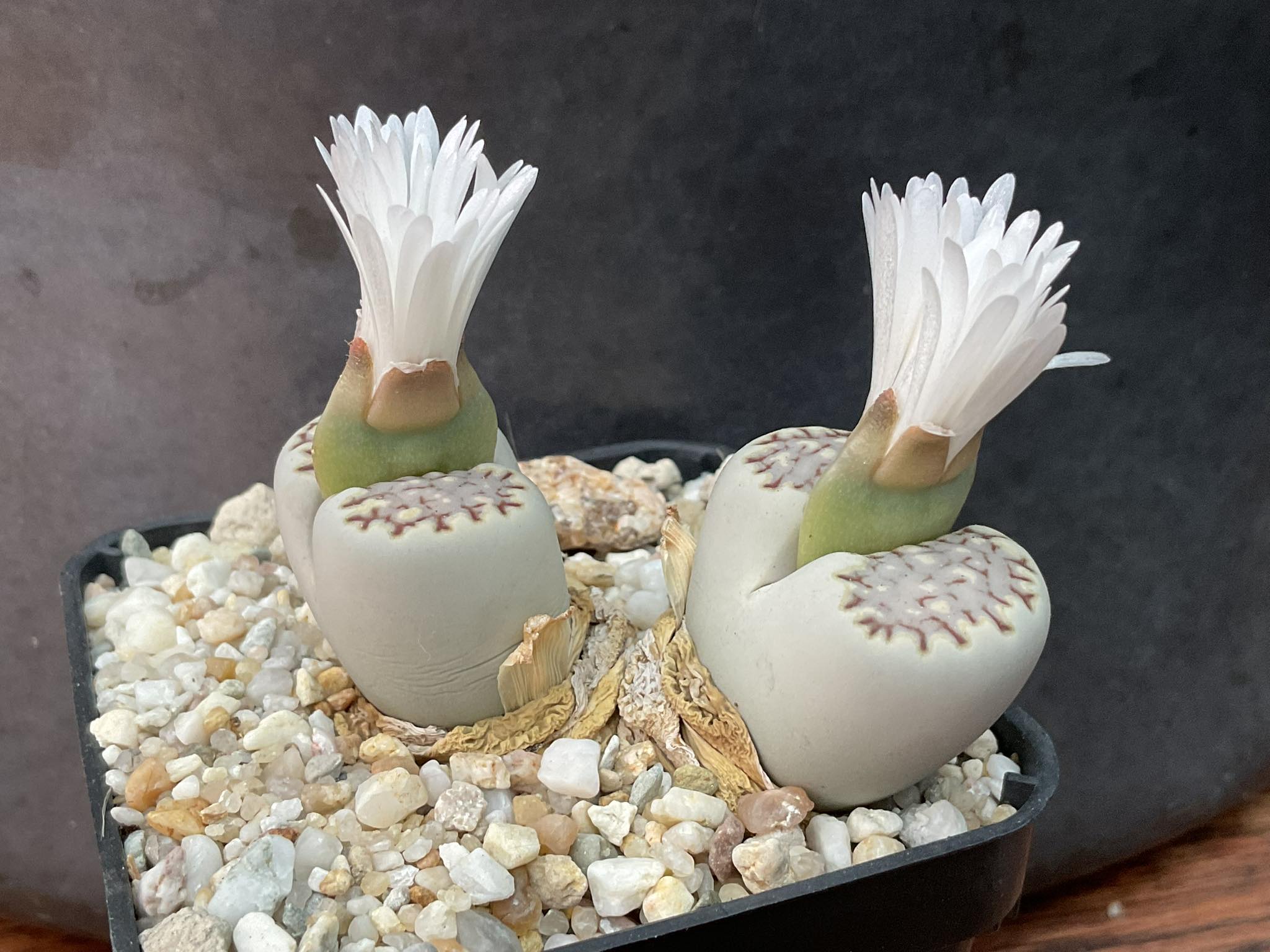
Lithops julii subsp. fulleri (N.E.Br.) B.Fearn is the Kenhardt-Pofadder Northern Cape form of Lithops julii, distinguished from the Namibian nominate by the absence of its brown lip-smear, by rust-brown lines running between the lobes of the margin, and by a paler and noticeably more variable face ground colour. The taxonomic standing of this name is contested. Kew POWO treats both the original species name L. fulleri N.E.Br. and the subspecific combination L. julii subsp. fulleri as heterotypic synonyms of L. julii and recognises no infraspecific taxa under the species. The South African National Biodiversity Institute assesses the subspecies separately for conservation purposes at Least Concern. The international trade and the Cole monograph use the subspecies name without qualification.
Nicholas Edward Brown described the Kenhardt plants as a distinct species, Lithops fulleri, in Gardeners’ Chronicle of 22 January 1927, the same year he formally established the genus Lithops itself. The specific epithet honours Ernest Russell Fuller, postmaster of Kenhardt in the Northern Cape, who sent the type material to Kew. Brian Fearn republished the taxon at subspecific rank under L. julii in National Cactus and Succulent Journal 31(3): 59 in September 1976, recognising that the Kenhardt populations were close to the Namibian nominate but distinguished by face character and by a clean geographic disjunction across the Orange River. Cole’s 1988 monograph affirmed the subspecies treatment, and that has governed the specialist trade ever since. POWO’s synonymy is the more recent algorithm-driven lump and is the formally accepted treatment under Kew today; the trade and SANBI continue with the Cole reading.
The page is built under the subspecies name because that is what collectors search for, what the trade puts on every seed packet, and what SANBI uses on its conservation page. Where the wider ecology, seasonal calendar, and substrate framework apply equally to both subspecies they are covered on the parent L. julii page; this page focuses on what is actually different about the Northern Cape form. The closest comparator on this site is the white-flowered, intricately patterned Lithops karasmontana of the Namibian Karas Mountains, which shares the white autumn flower and overlapping body palette but lacks the nominate julii’s lip-smear character that subsp. fulleri negates. Among the named selections within fulleri, the cultivar ‘Fullergreen’ (Cole locality C056A, 25 km southwest of Pofadder) is the most widely traded, identifiable by its creamy greenish-grey ground and notably blue-green windows.
Lithops julii subsp. fulleri quick reference
Population-specific values for the Kenhardt-Pofadder Northern Cape form, calibrated for seed grown plants in cultivation. Where care tracks the parent species without modification (winter-active seasonal calendar, summer dormancy, light requirements) the widget carries the parent baseline; the substrate row also notes an optional limestone-chip variant that the plant does not require.
Taxonomy & nomenclature
The taxon currently traded as Lithops julii subsp. fulleri (N.E.Br.) B.Fearn has had three separate names across its taxonomic life. N.E. Brown described the Kenhardt material as a full species, Lithops fulleri, in Gardeners’ Chronicle Series III, 81: 70 (22 January 1927). For nearly five decades the Kenhardt plants circulated as a separate species. Brian Fearn republished the taxon at subspecies rank under nominate L. julii in National Cactus and Succulent Journal 31(3): 59 (September 1976), creating the combination still in use across the specialist trade. D.T. Cole’s 1988 monograph and the revised 2005 edition both accept the subspecific rank, and Cole’s C-number system catalogues populations across the subspecies range from C024 in the Kenhardt district to C416 east toward Upington.
Kew POWO does not recognise any infraspecific taxa under L. julii. Both the original species name L. fulleri N.E.Br. and the Fearn 1976 subspecific combination appear in the POWO synonymy list rather than in an accepted infraspecific block. Under the strictest current Kew treatment the Kenhardt plants are simply L. julii. The POWO read reflects an algorithm-driven homogenisation of infraspecific mesemb taxa across many genera and is the most conservative authority available; the Cole monograph, with its field-derived C-number documentation across the Kenhardt-Pofadder-Upington arc, is the stronger authority for on-the-ground identification and is what every specialist nursery and seed house follows.
SANBI splits the difference institutionally: the South African National Biodiversity Institute Red List of South African Plants assesses Lithops julii subsp. fulleri as a separate entity (Least Concern, 2006), giving the subspecies a live institutional read for conservation purposes. The subspecies name therefore has three parallel lives: a Kew synonymy, a SANBI conservation entity, and a trade-standard horticultural taxon. This page builds under the subspecies name, surfaces the synonymy upfront, and treats the population as a coherent diagnosable entity for the purposes of identification and cultivation.
Within the subspecies, two named selections persist in trade: the cultivar ‘Fullergreen’ (parent locality C056A, 25 km southwest of Pofadder), with a creamy greenish-grey ground and blue-green windows, and var. brunnea (type locality C179, 10 km northeast of Pofadder), with browner colouration. POWO does not accept var. brunnea as a distinct taxon and treats it as part of the subspecies’s natural variation; specialist seed houses still list it under the var. name. The basionym chain runs from Mesembryanthemum-era starting points through L. fulleri to the current subspecific name.
Habitat
Subsp. fulleri is endemic to the Northern Cape Province of South Africa, occupying a roughly 400 km east-west arc of arid Namaqualand from the Kenhardt district through Kakamas, south and southwest toward Pofadder and Springbok, and east toward Upington. The range sits entirely south of the Orange River; no records have been confirmed from Namibia. This geographic separation from the nominate subspecies (which occupies the Warmbad-Karasburg belt of southern Namibia north of the Orange River) is the main argument for treating the two as distinct entities even where strict POWO synonymy would lump them. There is no documented overlap between the two ranges.
The substrate is variable across the arc: pegmatitic granite in fine grit at some localities, calcrete-cemented gravel in coarser form at others, and granitic soils with calcareous inclusions across most of the range. All exposures are mineral, fast-draining, and effectively zero in organic matter. The substrate reads softer in colour than the pure quartzite fields of some other Lithops habitats, with pinkish-white to cream-grey backgrounds that the plants colour-match across the range. This substrate diversity differs from the more uniform quartz of the parent species’s Namibian habitat and is one of the field characters Cole used to defend the subspecific rank.
Climate is semi-arid winter-rainfall Namaqualand, with annual totals at most localities in the 100–250 mm range arriving predominantly as winter frontal rains from May through August. Summer (November through March) is hot and dry. The subspecies sits at the cooler and slightly wetter end of the Lithops climate envelope, marginally less harsh than the nominate’s further-north Namibian range. Plants sit flush with or slightly below the substrate surface, with only the dorsal face exposed; bodies align with the surrounding pebble matrix in size and colour, producing the genus-typical mimicry. Associated flora is Succulent Karoo shrubland: dwarf restios, small Ruschia and Cephalophyllum mesembs, Osteospermum suffrutices, and winter-season geophytes.
Morphology
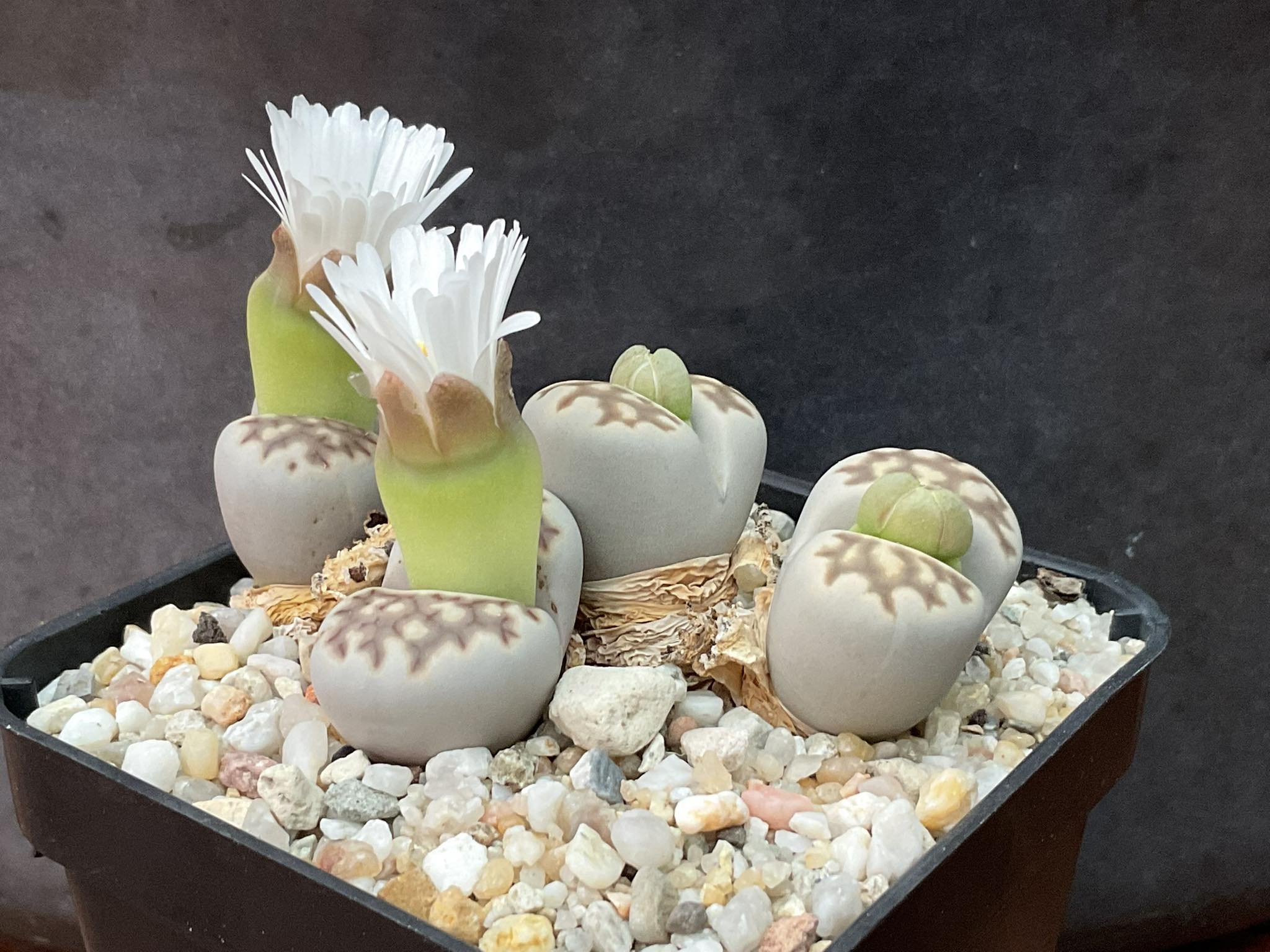
Body form follows the standard Lithops architecture shared with the parent species: a single pair of fused leaves forming an obconic to conical body that sits flush with or slightly below the soil surface, with only the slightly reniform dorsal face exposed. Bodies are approximately 25 mm tall and 20–30 mm broad, smaller on average than nominate L. julii, solitary or clumping to roughly fifteen heads in mature plants. The plant is essentially stemless. Where this account differs from the parent julii morphology is on the face, which is the only place the subspecific separation lives.
The face ground colour is the most obviously variable character across the subspecies and is what makes fulleri the trickiest taxon in the julii complex to name from a single specimen. Shoulders, margins, and islands run light grey, often with tinges of pink, yellow, blue-green, or beige. Windows and channels read opaque greyish blue-green, milky, pale pinkish-green, or in some Pofadder-area populations mauve, pink, or rust-brown. The overall effect is softer and lighter than the stronger grey-brown of nominate L. julii. Two plants from different Cole C-numbers can look quite different at the face level, which is why the trade catalogues this subspecies by C-number wherever possible.
Two characters anchor the diagnostic separation from nominate L. julii. First, the brown lip-smear that runs along the inner fissure margins of the nominate subspecies is absent or very reduced in fulleri. The lip-smear is the load-bearing diagnostic of nominate julii and its absence is the single most reliable field character separating the two. Second, where nominate plants carry the inner-margin smear, fulleri instead develops rust-brown lines running mainly between the lobes of the margin. The visual rhythm is different: a smeared dark inner edge in the nominate, fine radiating or marginal lines in the subspecies. Flowers are white and daisy-form, large relative to body size, single per leaf pair, opening in autumn from the central fissure. Flower character is identical to the parent and is not a distinguishing trait. The cultivar ‘Fullergreen’ (C056A) reads as a particularly clean expression of the subspecies face: creamy greenish-grey ground with markedly blue-green windows.
Locality detail
The type locality for the original species name Lithops fulleri N.E.Br. is the Kenhardt district of Namaqualand in the Northern Cape, where Ernest Russell Fuller collected the material that he sent to Kew in the 1920s. Fuller served as postmaster at Kenhardt and was an active correspondent and plant collector across the Northern Cape during that period; Brown took the holotype material and described it in Gardeners’ Chronicle in early 1927. The Kenhardt district sits roughly 800–1,000 m above sea level on the western edge of the Bushmanland escarpment, and the type-area populations are catalogued today as Cole C024 (Kenhardt district) and C203 (15 km south-southeast of Kenhardt).
The map above marks the type locality alongside the four load-bearing trade and named-selection localities for the subspecies. C056A, 25 km southwest of Pofadder, is the parent population for the cultivar ‘Fullergreen’ and the single most-cited locality in the international trade for this subspecies. C179, 10 km northeast of Pofadder, is the type locality for var. brunnea, the browner-coloured form that POWO does not accept but specialist seed houses still list. The Kakamas locality at C062 and the C171 population 60 km west of Upington trace the range out to its eastern limits along the Orange River corridor. The full Cole documentation runs from C024 in the type area to C416 east of Upington and covers a 400 km east-west arc; this map shows only the trade-significant subset to keep the locality view legible.
Lithops julii subsp. fulleri care and cultivation
Cultivation tracks the parent L. julii page without modification on the load-bearing axes: the inverted Lithops seasonal calendar (active September through April, dry dormancy May through August), the full-sun light requirement, the unglazed terracotta container baseline, and the 5°C dry cold floor. Read the parent page for the complete month-by-month watering schedule and the genus-wide rationale for the inverted calendar; this section covers only the population-specific inflections that distinguish fulleri cultivation from nominate julii cultivation.
Any change from the parent mix is small. The Kenhardt-Pofadder arc carries pegmatitic granite and calcrete in roughly equal measure across the populations, where the nominate Namibian range tends more uniformly to quartz-limestone, but habitat rock is not what sets the pot mix. An alternative mix runs 40% pumice, 20% silica grit, 5% crushed limestone chip (1–2 mm), 15% granite grit, 10% zeolite, and 5% worm castings, with the limestone chip itself accounting for 5% of the total mix. The plant does not require the chip. Hard tap water already supplies calcium and bicarbonate at every watering, while rainwater and RO water supply neither, so check your water before adding the chip. This is optional rather than mandatory: the parent 95/5 mesemb default works for fulleri as well. The site-wide bans on the usual organic and lightweight aggregate ingredients apply here as for every Lithops on this site; see the parent page for the full rationale.
The variability across Cole C-numbers is the practical wrinkle for collectors growing this subspecies for face character. Two plants labelled simply “L. julii subsp. fulleri” with no locality data can read as quite different in colour and window expression after a few years in cultivation, particularly across the cream-pink-mauve ground-colour range. Source seed by Cole C-number where possible: C056A produces the ‘Fullergreen’ cream-green expression reliably; C179 produces var. brunnea’s browner colouration; the wider C-numbers across the type-area Kenhardt district produce the standard pale-grey-with-rust-line face that anchors the subspecific concept.
Comparison
The single most useful comparison is with the nominate subspecies Lithops julii itself. The two are the same species under strict POWO terms but read as visibly different plants in cultivation. Nominate julii carries a defined brown lip-smear along the inner fissure margins, sits in a stronger whitish-grey to dark grey ground colour, runs slightly larger on average, and lives on the Namibian side of the Orange River around Warmbad and Karasburg. Subsp. fulleri lacks the lip-smear, carries rust-brown lines between margin lobes instead, sits in a paler and more variable cream-grey-pink-blue-green palette, runs slightly smaller, and lives on the South African side of the Orange River from Kenhardt to Upington. Both flower white in autumn; the flower is not a distinguishing trait and cannot be used for identification.
Across the wider genus, the closest visual comparator is Lithops karasmontana of the Namibian Karas Mountains, which shares the white autumn flower and overlapping cream-grey-brown body palette. L. karasmontana is recognisable in turn by its characteristic deep red-brown channel network across the face, absent in fulleri; the rust-brown elements in fulleri sit at the margins as discrete lines, not as an internal channel network. The Sperrgebiet endemic Lithops optica sits at the opposite end of the genus on body character: translucent grey-green windows nearly covering the dorsal face, no marginal patterning of any kind. L. lesliei and L. aucampiae are immediately separated by their yellow flower colour.
Within fulleri itself, the cultivar ‘Fullergreen’ from C056A is the clean cream-green expression with notably blue-green windows; var. brunnea from C179 is the brown-tinged form; the type-area Kenhardt populations sit between the two with a paler grey ground and the standard rust-brown marginal-line pattern. POWO accepts none of these names below the species rank, and SANBI assesses only the subspecies as a whole; the cultivar and var. names are trade currency rather than formal taxa. Source by Cole C-number where the face character matters.
Frequently asked questions
Is Lithops julii subsp. fulleri hard to grow?
Intermediate. The subspecies sits at the same difficulty level as the parent L. julii: the inverted seasonal calendar is the only real obstacle. Lithops grow in autumn and winter and rest dry through summer, the opposite of every cactus on this site, and growers carrying their cactus watering instincts across to a Lithops pot kill plants in the first June. Once the calendar is internalised, fulleri is reliable. The harder thing for collectors is the variability of face character across Cole C-numbers; sourcing seed by C-number is the way to get a predictable expression of the cream-green ‘Fullergreen’ type or the browner var. brunnea type.
Can Lithops julii subsp. fulleri be grown from seed?
Yes, and seed is the standard propagation route. Seeds germinate in 3–14 days at 20–25°C day with cooler nights around 10–15°C, surface-sown without cover on a fine mineral seedling mix kept consistently moist for the first two weeks. Time to first flower is 3–4 years under good cultivation with respected dormancy. Grafting is not standard practice for Lithops and grafted plants are essentially unknown in collector circles. Specialist seed houses (Mesa Garden, Köhres, dedicated mesemb nurseries) carry the subspecies under Cole C-numbers for predictable face character.
Is Lithops julii subsp. fulleri legal to own?
Yes, with no CITES paperwork. The taxon is not listed on any CITES appendix because the family Aizoaceae is not covered by the Cactaceae blanket Appendix II listing; the no-CITES status is the load-bearing legal distinction between Lithops and most of the other rare succulents on this site. Wild collection inside South Africa requires a permit under NEMBA (National Environmental Management: Biodiversity Act, Act 10 of 2004) and conformance with Northern Cape provincial conservation regulations. SANBI assesses the subspecies as Least Concern (2006) with a stable population trend, so the wild-collection pressure is documented as low for this taxon. Nursery-propagated material with documented seed-grown provenance is the legally and ethically defensible source for collector specimens worldwide; international trade in nursery stock is unrestricted by CITES.
Where does Lithops julii subsp. fulleri grow in the wild?
Northern Cape Province, South Africa, in a roughly 400 km east-west arc from the Kenhardt district through Pofadder and Kakamas to near Upington. The range sits entirely south of the Orange River and does not extend into Namibia. Type locality is the Kenhardt district of Namaqualand, where Ernest Fuller collected the original material in the 1920s. Habitat is winter-rainfall Namaqualand at roughly 800–1,000 m elevation on pegmatitic granite, calcrete, and granitic-soil substrates with negligible organic matter. Plants grow flush with the substrate surface and colour-match the surrounding pebble matrix so completely that field surveys are practical only in the autumn flowering window. The clean Orange River separation from the Namibian range of nominate L. julii is one of Cole’s arguments for retaining the subspecific rank that POWO synonymises.
When does Lithops julii subsp. fulleri flower?
Autumn. In Northern Hemisphere cultivation the flowering window runs late October through December, corresponding to Southern Hemisphere autumn (April through May) in habitat. Flowers are white, daisy-form, large relative to body size (often equalling or exceeding the body in diameter), single per leaf pair, opening from the central fissure. Yellow centre, white rays. Flower colour is identical to the parent L. julii and is not a character that distinguishes the subspecies; identification between nominate and subspecies depends on face character (lip-smear presence vs. absence, marginal-line pattern, ground colour palette) rather than flower. The species is an obligate outcrosser; flowers do not self-pollinate, so seed production in cultivation needs hand pollination between two genetically distinct plants.
Sources & further reading
Brown, N.E. (1927). Lithops fulleri N.E.Br., original species description. Gardeners’ Chronicle Series III, 81: 70 (22 January 1927) · Fearn, B. (1976). Lithops julii subsp. fulleri (N.E.Br.) B.Fearn, combination publication. National Cactus and Succulent Journal 31(3): 59 · Kew POWO. Lithops julii (Dinter & Schwantes) N.E.Br., with L. fulleri N.E.Br. and L. julii subsp. fulleri in synonymy. powo.science.kew.org · Cole, D.T. and Cole, N.A. (2005). Lithops: Flowering Stones (2nd ed.). Cactus & Co · SANBI Red List of South African Plants. Lithops julii subsp. fulleri, Least Concern, assessed 2006 by P.M. Burgoyne. redlist.sanbi.org/species.php?species=85-112 · llifle, Encyclopedia of Living Forms. Lithops julii subs. fulleri (Cole C-number documentation, type locality, morphology). llifle.com · llifle, Encyclopedia of Living Forms. Lithops fulleri N.E.Br. (1927 original description detail). llifle.com · llifle, Encyclopedia of Living Forms. Lithops julii subs. fulleri C056A cv. ‘Fullergreen’ (cultivar documentation). llifle.com · llifle, Encyclopedia of Living Forms. Lithops julii (nominate, for diagnostic contrast). llifle.com