
Lithops karasmontana subsp. amicorum
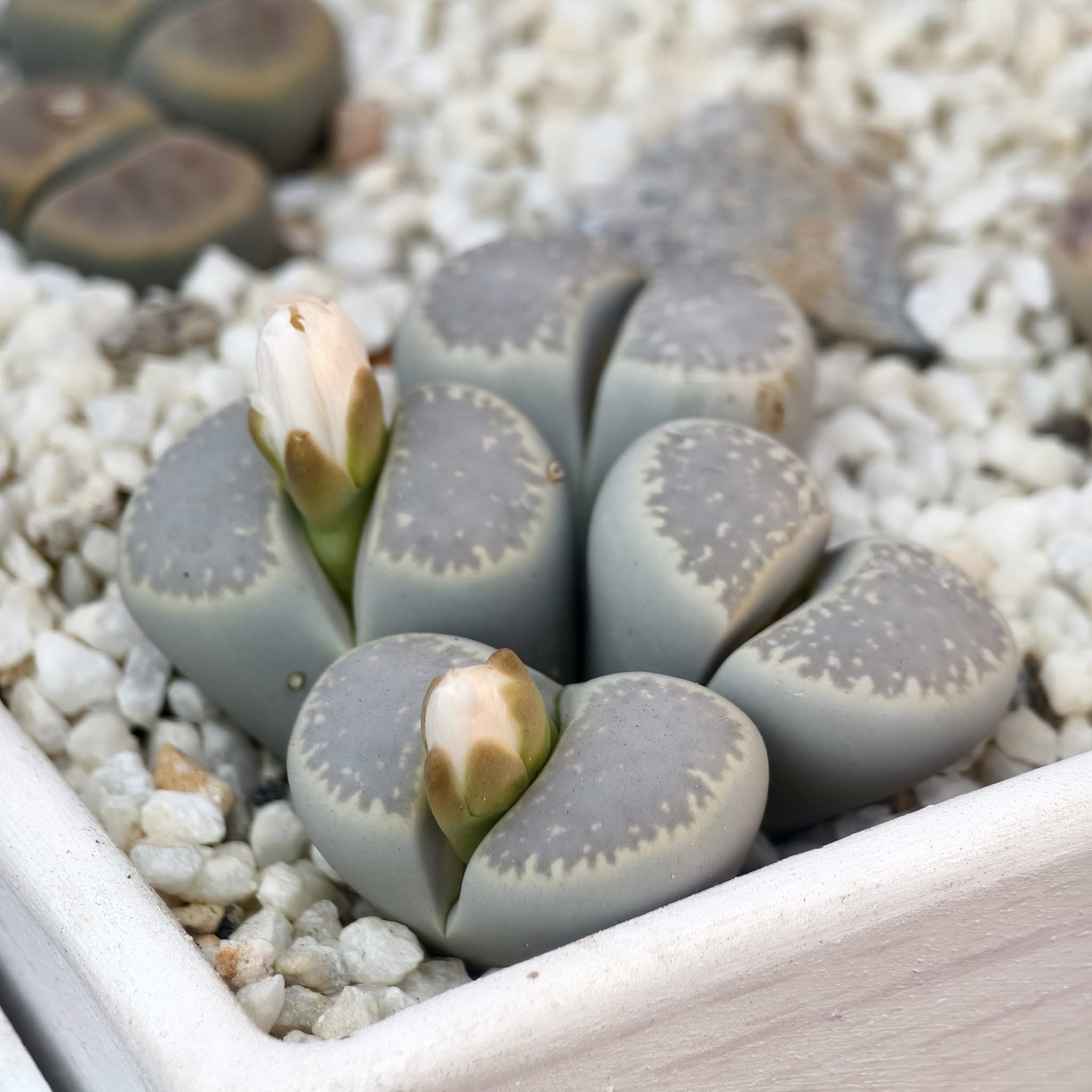
Lithops karasmontana subsp. amicorum (D.T.Cole) Loots & Ritz is the rarest and most geographically restricted member of the karasmontana complex, and a strong candidate for the smallest Lithops in the genus. Bodies measure only 10 to 15 millimetres across the face, roughly one third the diameter of the nominate Lithops karasmontana, with a whitish-grey to pale bluish-grey face, an opaque window flecked with grey islands, and channels that are largely absent or vestigial. The subspecies is known from three colonies near Aus in southwestern Namibia, with as few as 32 individual plants formally marked and monitored across the entire known range.
Desmond Thorne Cole described the taxon in 2006 as a full species, Lithops amicorum D.T.Cole, in Cactus & Co. 10(1): 59, from a type collection (Cole C410) made with his wife Naureen on 3 May 2004 in the company of Tok Schoeman and Steve Hammer. Loots and Ritz reduced it to subspecific rank in 2019 on AFLP molecular evidence published in Plant Systematics and Evolution 305: 997, where the amicorum populations clustered with karasmontana rather than supporting independent species rank. Plants and seeds in the collector trade still move almost exclusively under the former name; the rename has not yet propagated through specialist seed lists or commercial catalogues.
The Latin epithet amicorum is the genitive plural of amicus, ‘of friends’. Cole named the subspecies for the small group involved in its discovery: Tok Schoeman, who first photographed an unrecognised Lithops on a Namibian field excursion in the early 2000s and sent the images via Steve Hammer to Cole; and Cole and his wife Naureen, who joined the 2004 expedition that led to the type collection. The narrowness of the discovery group is part of the conservation reality: the plant was unknown to formal botany until the 21st century and remains one of the latest Lithops taxa described.
Within the karasmontana complex, the closest visual neighbour is L. karasmontana subsp. bella, which sits approximately 70 to 80 kilometres northwest of the amicorum colonies, near Aus itself, and which differs in carrying a transparent pellucid window with a distinctly larger body that clumps to as many as 60 heads. The pattern-cultivar Lithops amicorum ‘Freckled Friend’, with darker reddish marks resolving into longer lines as the plant matures, is the only named cultivar of the subspecies and is the form most commonly seen in specialist seed lists alongside wild-type Cole C410 stock. Because this is a form-of-species page, full Lithops cultivation philosophy, the inverted winter-grower calendar, the 95% mineral substrate framework, and the species-level habitat ecology are covered on the parent L. karasmontana page; this page focuses on what is distinctive about the amicorum subspecies.
Lithops karasmontana subsp. amicorum quick reference
An exceptionally small Lithops from quartzite-feldspar terrain southeast of Aus in southern Namibia. Cultivation values are the parent karasmontana framework with one important amicorum-specific delta: the 10 to 15 millimetre body holds noticeably less moisture reserve than a standard 30 millimetre Lithops, which narrows the margin for watering timing errors. Treat as marginally more demanding than the nominate species.
Taxonomy & nomenclature
The accepted name is Lithops karasmontana subsp. amicorum (D.T.Cole) Loots & Ritz, with Kew POWO carrying the combination at IPNI lsid urn:lsid:ipni.org:names:77203975-1. The basionym is Lithops amicorum D.T.Cole, published in Cactus & Co. 10(1): 59 (March 2006), based on Cole C410, collected by D.T.Cole and N.A.Cole on 3 May 2004 at the type locality 75 kilometres southeast of Aus in Namibia. The holotype and isotype are deposited at the WIND herbarium (National Herbarium of Namibia, Windhoek).
The recombination at subspecific rank was published by Sonja Loots and Christiane Ritz in 2019 as part of a wider AFLP molecular study of Namibian Lithops populations: Loots, Nybom, Schwager, Sehic and Ritz, ‘Genetic variation among and within Lithops species in Namibia’, Plant Systematics and Evolution 305: 997 (2019). The study examined 44 wild populations spanning 15 species and 23 taxa and found that the amicorum samples clustered genetically with karasmontana rather than supporting independent species status. POWO accepts the subspecific combination; the older specific name remains valid as a basionym and persists in the trade.
The trade has not adopted the rename. Almost every commercial seed list, nursery catalogue, and forum reference continues to use Lithops amicorum rather than L. karasmontana subsp. amicorum. Mesa Garden lists the wild-type stock under catalogue number 1541.983 with the Cole C410 provenance; Cape Succulent Seeds offers seeds from the Tok Schoeman field collection under the provenance code Tok67. Collectors searching for the plant should expect to find it under either name. POWO currently recognises four subspecies of L. karasmontana: the nominate, subsp. bella, subsp. eberlanzii, and subsp. amicorum.
One named cultivar exists, L. amicorum ‘Freckled Friend’, a pattern selection in active specialist trade as of 2026 (OzLithops, Lifestyle Seeds South Africa). The selector and registration year are not documented in sources accessed for this page; the cultivar is described in detail in the Comparison section below.
Historical synonym (1)
- Lithops amicorum D.T.Cole, 2006 basionym
Sources: GBIF
Habitat
Subsp. amicorum is restricted to three colonies approximately 75 kilometres southeast of Aus in the ǀKaras Region of southwestern Namibia (grid square -2716BB at the type). The substrate is a mixture of white, grey, and yellow quartzite chips and feldspar gravel; the plants sit flush with the surface and mimic the gravel so completely that they are extremely difficult to detect outside the autumn flowering window. The wider climatic envelope, winter-rainfall Namibian interior with hot dry summers and cold clear winters, is described in full on the parent karasmontana page. The amicorum colonies sit south-southeast of the nominate’s Great Karasberg range and southeast of subsp. bella’s type locality near Aus; the three subspecies are geographically near but not sympatric.
Morphology
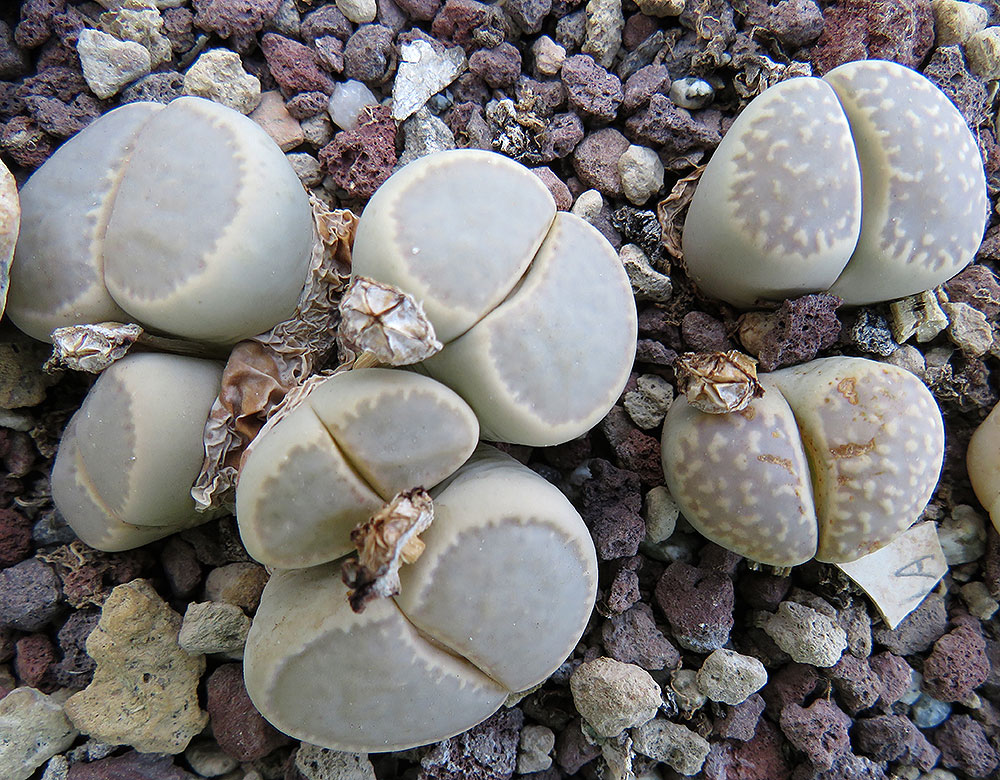
Body size is the headline character. Mature subsp. amicorum bodies measure 10 to 15 millimetres across the face, distinctly smaller than the nominate karasmontana (face up to 35 millimetres wide) and roughly half the size of subsp. bella and subsp. eberlanzii, both of which carry bodies in the 25 to 30 millimetre range. At the smaller end of the amicorum range, the subspecies sits at or near the size floor for the entire genus and is one of the first taxa specialists name when asked which Lithops is the smallest. The size is visible without measurement in side-by-side comparison with any of the larger karasmontana forms and is the single most useful field character for identification.
Face colour runs whitish-grey to pale bluish-grey, with a ground tone described as grayish, beige, pinkish-grey, or bluish-white. The cool pale quality is distinct from the warmer grey-brown of the nominate, the buff-cream of subsp. bella, and the violaceous grey of subsp. eberlanzii. The bluish tinge is strongest under strong light, consistent with a photostress anthocyanin response. The window is wide and opaque to semi-opaque, beige or grey, with numerous grey islands of varying size; channels are largely absent or vestigial, with the margin discernible but not sharply defined. The combination of opaque many-islanded window and absent channels separates amicorum from the nominate karasmontana’s channelled network of reddish-brown to ochre rubrications. Plants form small clumps of typically 2 to 4 heads, limited by body size and the slow growth rate that follows from it.
Flowers are white and appear relatively large in proportion to the diminutive body, with diameters reaching approximately 25 millimetres. Flowering occurs in autumn, consistent with the wider karasmontana species complex and with the standard Lithops autumn-flowering window described on the parent page. Plants generally require at least three years from seed to first flower, with the slow body development imposed by the small size sometimes lengthening this to four years under cooler or shadier cultivation.
Locality detail
The type locality of subsp. amicorum is approximately 75 kilometres southeast of Aus in the ǀKaras Region of southwestern Namibia, recorded by Cole and Cole on 3 May 2004 and assigned the field number Cole C410. The grid square per the IPNI record is -2716BB and the substrate at the locality is the mixed white, grey, and yellow quartzite and feldspar gravel that gives the plants their substrate-mimicking pale face. The other two known colonies sit in the same broader ǀKaras Region cluster; their precise locations are tracked by the Lithops Research and Conservation Foundation monitoring programme but are not GPS-published, and the map above approximates them for conservation reasons rather than publishing sharp coordinates that could be used by collectors to locate the wild plants.
Across the three colonies, only 32 individual plants have been formally marked and are monitored at least three times per year by the Foundation. The true wild population may be larger than 32 if unmonitored plants exist in the surrounding terrain, but 32 is the documented count from monitoring data summarised by GBIF and by Earle’s 2022 conservation overview in Bradleya. By any reading, this is one of the smallest documented wild populations of any Lithops taxon. The amicorum range sits approximately 100 kilometres south-southeast of nominate karasmontana’s Great Karasberg centre near Grünau and Klein Karas, and approximately 70 to 80 kilometres southeast of subsp. bella’s type locality 5 kilometres south of Aus.
Lithops karasmontana subsp. amicorum care and cultivation
Subsp. amicorum follows the genus Lithops calendar and the parent karasmontana framework without modification at the level of substrate, watering season, light, or cold floor. Full guidance on the 95% mineral mesemb mix, the inverted autumn-active and summer-dormant watering calendar, full-sun light, the −3°C dry cold floor, and the annual leaf-pair replacement cycle is on the parent karasmontana page; this section covers only what is amicorum-specific.
Watering tolerance and body size
The one documented difference from the parent species follows from body size. A 10 to 15 millimetre amicorum body holds noticeably less stored water than the 25 to 35 millimetre body of the nominate karasmontana, narrowing the buffer against misjudged watering timing. Specialists treat amicorum as marginally more sensitive to overwatering and less forgiving of calendar errors than a full-sized Lithops: err on the lighter side of the autumn schedule and be strict about the summer-dormant dry period. New growers should master a full-sized karasmontana or L. lesliei before attempting amicorum.
Container and seed
The miniature body is easy to lose in a mixed Lithops collection. Specialists who keep amicorum long-term keep it in its own designated container with the plant’s position visibly marked, in unglazed terracotta or clay composite 8 to 10 centimetres deep (slightly shallower than the standard Lithops 10 to 12 centimetre recommendation, since the root mass is proportionally smaller). A 2 to 3 millimetre quartzite top dressing matches the habitat and helps locate the plant when the body shrinks into summer dormancy. Seeds are commercially available under the Cole C410 wild-type provenance (Mesa Garden 1541.983), the Tok Schoeman Tok67 line (Cape Succulent Seeds, Lifestyle Seeds South Africa), or as the cultivar ‘Freckled Friend’; pricing sits within the normal specialist Lithops range. Grafting is not practised for Lithops in any context, and seed grown is the only cultivation pathway.
Comparison
Across the other two karasmontana subspecies, amicorum is smaller than both and visually distinct from both. Subsp. bella from near Aus carries a transparent pellucid window with a buff-coloured border and forms very large clumps of up to 60 heads; the pellucid window alone separates it unambiguously from amicorum’s opaque many-islanded version. Subsp. eberlanzii from south and east of Aus and east of Lüderitz carries a dark green opaque window with approximately twenty uniform marginal teeth and a sunken window margin; the green window tone and the prominent teeth separate it from amicorum’s smooth-margined grey-island face.
Beyond the karasmontana complex, the closest visual confusion in cultivation is with the smallest individuals of Lithops julii, which can carry similarly cool grey face tones but with the diagnostic red-brown lip-smear face markings absent from amicorum, and with bodies considerably larger than the amicorum 10 to 15 millimetre dimension. The cultivar ‘Freckled Friend’ differs from wild-type amicorum in carrying darker, more prominent reddish markings that resolve into longer lines and dashes as the plant matures, with the same bluish photostress shading; it is the only named cultivar of the subspecies.
Frequently asked questions
How is Lithops karasmontana subsp. amicorum different from the typical L. karasmontana?
Three characters separate the subspecies from the type. Body size is the headline: subsp. amicorum bodies measure only 10 to 15 millimetres across the face, roughly one third the size of the nominate karasmontana’s 25 to 35 millimetre face. Window character is the secondary character: amicorum carries an opaque grey or beige window flecked with multiple grey islands and lacks the channelled network of reddish-brown lines that traverses the nominate karasmontana’s window. Face tone is the tertiary character: amicorum is whitish-grey to pale bluish-grey, cooler than the nominate’s warmer grey-brown and pinkish-grey. Any one of the three is sufficient to make the call in cultivation, and the combination is definitive.
Is Lithops karasmontana subsp. amicorum hard to grow?
Intermediate to advanced. The subspecies follows the same inverted Lithops calendar as every other taxon in the genus, but its 10 to 15 millimetre body holds noticeably less moisture reserve than a standard Lithops, which narrows the margin for watering timing errors. New growers who have mastered a full-sized L. karasmontana or L. lesliei before attempting amicorum consistently fare better than those starting on the small subspecies directly. The full cultivation framework is the same; the consequence of misjudgment is amplified by the small body.
Can Lithops karasmontana subsp. amicorum be grown from seed?
Yes, and seed is the only standard propagation route for the subspecies. Seeds are commercially available from specialist suppliers under either the Cole C410 wild-type provenance (Mesa Garden catalogue 1541.983) or the Tok Schoeman Tok67 collection line (Cape Succulent Seeds, Lifestyle Seeds South Africa); the cultivar ‘Freckled Friend’ is offered separately through specialist channels. Germination is the standard Lithops procedure on a mineral-heavy fast-draining mix; the multi-year wait to a flowering-sized body is the genuine difficulty, since the small adult dimension imposes very slow growth and first flower can take three to four years from seed grown plants. Grafting is not practised for Lithops in any context.
Is Lithops karasmontana subsp. amicorum legal to own?
Yes, with no CITES paperwork. The Aizoaceae are not covered by the Cactaceae blanket Appendix II listing, so the subspecies carries no CITES restriction; nursery-propagated material with documented seed grown provenance moves freely across borders without permits. Wild collection inside Namibia is prohibited under the Nature Conservation Ordinance 4 of 1975, which protects indigenous succulent plants and requires a permit from the Minister of Environment, Forestry and Tourism for any wild material. Given that only 32 individual wild plants have been formally marked across the three known colonies, the ethical case for buying only documented Cole C410 or Tok67 nursery stock is overwhelming.
Where does Lithops karasmontana subsp. amicorum grow in the wild?
In three colonies approximately 75 kilometres southeast of Aus, in the ǀKaras Region of southwestern Namibia. The plants grow flush with the surface of white-grey-yellow quartzite and feldspar gravel, mimicking the substrate so completely that they are extremely difficult to detect outside the autumn flowering window. The type locality (Cole C410, 3 May 2004) is in grid square -2716BB. Across the three colonies, only 32 individual plants have been formally marked and are monitored at least three times per year by the Lithops Research and Conservation Foundation. Few Lithops taxa occupy so restricted a documented range.
Sources & further reading
Cole, D.T. (2006). Lithops amicorum D.T.Cole. Cactus & Co. 10(1): 59 · Loots, S., Nybom, H., Schwager, M., Sehic, J. and Ritz, C.M. (2019). Genetic variation among and within Lithops species in Namibia. Plant Systematics and Evolution 305: 997 · Kew POWO. Lithops karasmontana subsp. amicorum (D.T.Cole) Loots & Ritz, IPNI lsid urn:lsid:ipni.org:names:77203975-1. powo.science.kew.org · Kew POWO. Lithops amicorum D.T.Cole, basionym, urn:lsid:ipni.org:names:77073634-1. powo.science.kew.org · IPNI. Lithops amicorum D.T.Cole, urn:lsid:ipni.org:names:77073634-1. Type Cole C410 (3 May 2004), WIND herbarium · GBIF. Lithops amicorum D.T.Cole, species 5554410. gbif.org/species/5554410 · llifle, Encyclopedia of Living Forms. Lithops amicorum C410, TL: 75 km SE of Aus, Namibia. llifle.com · llifle, Encyclopedia of Living Forms. Lithops karasmontana subsp. bella and subsp. eberlanzii reference entries. llifle.com · Earle, R.A. (2022). Conservation research of Lithops N.E.Br. in Namibia and South Africa, a multi-decade term project. Bradleya 2022(sp40): 54–62 · Lithops Research and Conservation Foundation. Monitoring data (32 marked plants, 3x annual monitoring). lithopsfoundation.com (cited via GBIF) · Cole, D.T. and Cole, N.A. (2005). Lithops: Flowering Stones (2nd ed.). Cactus & Co · Mesa Garden. Lithops amicorum (C410) #1541.983. mesagarden.com · Cape Succulent Seeds. Lithops amicorum (Tok67). capesucculentseeds.com · Namibia. Nature Conservation Ordinance 4 of 1975. faolex.fao.org; lac.org.na · Wikipedia. Lithops amicorum; Lithops karasmontana. en.wikipedia.org