
Lithops julii
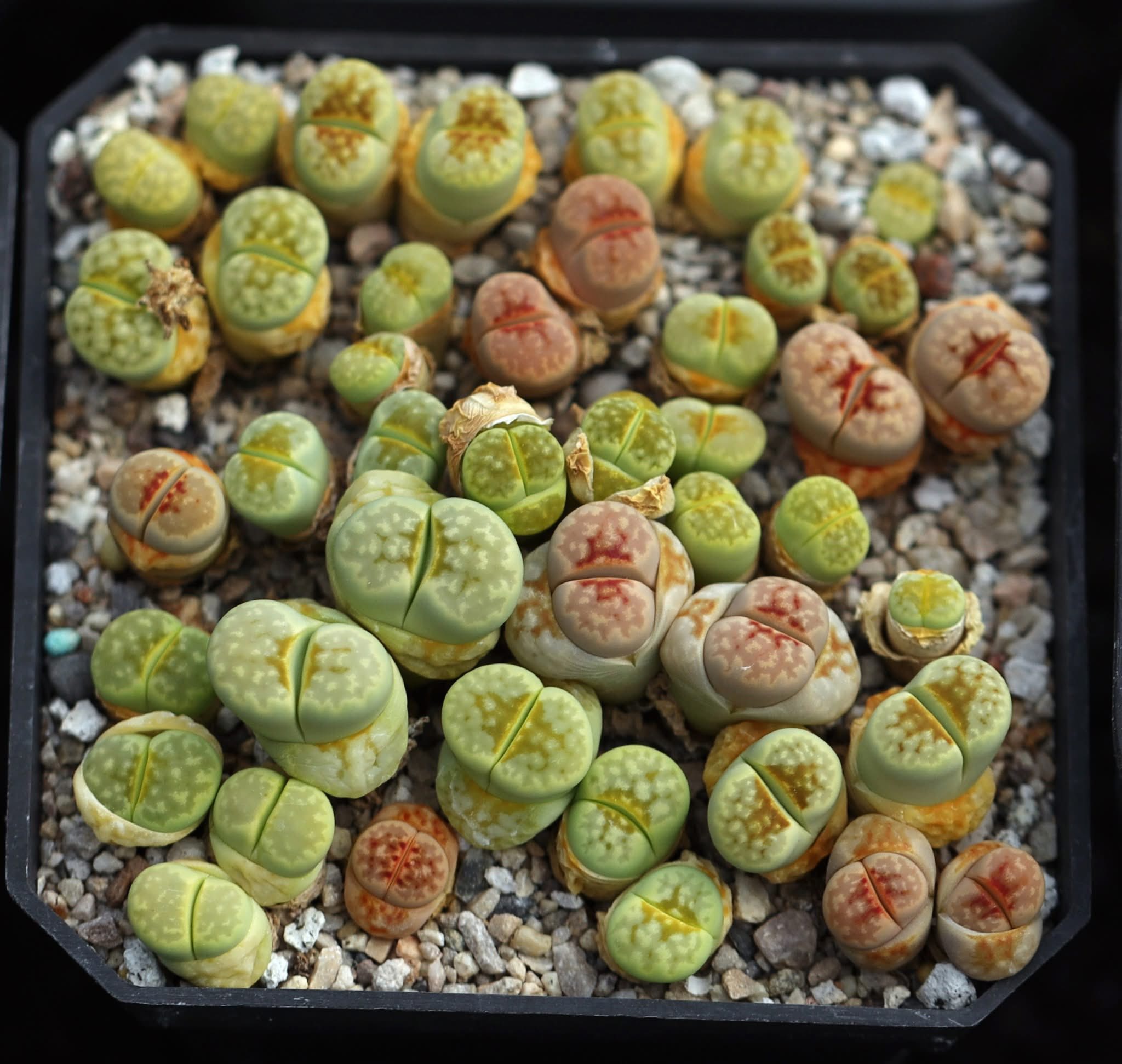
Lithops julii (Dinter & Schwantes) N.E.Br. is the lip-smear living stone of southern Namibia and the Northern Cape. Kurt Dinter and Martin Heinrich Gustav Schwantes described it first as Mesembryanthemum julii in 1922, and Nicholas Edward Brown transferred the species to the new genus Lithops in Gardeners’ Chronicle in 1926. The specific epithet honours Julius Derenberg, a friend of Dinter and a sponsor of his Namibian collecting trips. The diagnostic character that gives the species its collector value is the brown ‘lip-smear’ that lines the inner walls of the central fissure between the two fused leaves; this single feature separates nominate julii from every other species in the genus.
POWO accepts no subspecies or varieties under L. julii. The Cole-treatment subspecies L. julii subsp. fulleri covers the Northern Cape populations south of the Orange River and is treated by POWO as a heterotypic synonym; the on-site page at that slug carries the substrate, range, and conservation detail specific to those South African populations. The two names occupy non-overlapping ranges either side of the river: nominate julii sits in the Warmbad-Karasburg belt of the Namibian Karas Region; the fulleri populations sit between Kenhardt, Pofadder, and Upington in the Northern Cape. The lip-smear is present in nominate julii and absent or reduced to rust-brown lines between the lobes in the fulleri populations, which is the morphological reason Cole originally split them and the practical reason the on-site treatment carries them as separate pages despite POWO synonymy.
The cultivation calendar is the standard Lithops inverted schedule: active in autumn and winter, fully dormant May through July. This is the opposite of every cactus on this site, and the most common cause of catastrophic loss for growers carrying their cactus watering instincts into a Lithops pot. Compared with the more forgiving Lithops lesliei of the South African Highveld, L. julii is less tolerant of imprecise dormancy timing and rates as intermediate in difficulty rather than beginner. Plants in habitat in the Karas Region grow in quartz pebbles over desert limestone, with backgrounds of white, grey, pink, red, and brown that the body face mimics across its three named pattern forms: pallid, reticulated, and fuscous.
Flowers are white, daisy-form, 20-30 mm across, single per body, emerging from the central fissure in autumn (October-November in Northern Hemisphere cultivation). Flower colour is the primary character separating L. julii from the yellow-flowered L. lesliei, and the lip-smear is the primary character separating it from the white-flowered Lithops karasmontana of the higher Karas Mountains further north. Some pallid julii individuals approach the appearance of white (opalina) forms of karasmontana closely enough that field workers use the lip-smear as the deciding character.
Lithops julii quick reference
A southern Namibian winter-rainfall to bimodal-rainfall mesemb from the Karas Region; the calendar is inverted relative to every cactus on this site. Values calibrated for seed grown plants in cultivation, drawn from L. julii-specific habitat data and grower consensus across multiple specialist Lithops sources rather than genus-level extrapolation.
Taxonomy & nomenclature
The accepted name is Lithops julii (Dinter & Schwantes) N.E.Br., with the basionym Mesembryanthemum julii Dinter & Schwantes published in 1922. Brown transferred the species to his new genus Lithops in Gardeners’ Chronicle Series III, 79: 102 (1926). Kew POWO carries the 1926 combination as the current name (IPNI lsid urn:lsid:ipni.org:names:362450-1). The specific epithet honours Julius Derenberg, a friend of Kurt Dinter who supported the Namibian collecting work that produced the type specimen.
POWO accepts no infraspecific taxa under L. julii. The full POWO synonymy includes the basionym, plus Lithops fulleri N.E.Br. (1927, originally describing the South African populations), L. chrysocephala Nel, L. lactea Schick & Tischer, L. maughanii N.E.Br., L. julii subsp. fulleri (N.E.Br.) B.Fearn (1976, the Cole-treatment subspecies), L. julii subsp. rouxii (de Boer) R.A.Earle & A.J.Young (2020), L. julii var. rouxii de Boer (1964), and L. fulleri var. rouxii (de Boer) D.T.Cole (1973). The trade and specialist literature still routinely use the Cole subspecific names; this site carries the on-site treatment recommended by Cole 1988 and Cole & Cole 2005 on the L. julii subsp. fulleri page while flagging the POWO synonymy on both pages.
The taxonomic history reflects the high morphological variability of the complex across its range. The Namibian nominate populations and the South African populations were originally described as distinct species by Brown (Lithops julii 1926, L. fulleri 1927), then later combined under L. julii with subspecific rank for the South African populations by Fearn in 1976 and by Cole in 1988. POWO has since lumped all populations under L. julii without infraspecific rank, but SANBI continues to use subsp. fulleri in the South African conservation framework. The result is a two-tier system: POWO synonymises; SANBI and the collector community continue to use the Cole subspecific names as working names.
Historical synonyms (5)
- Lithops julii var. brunnea DeBoer, homotypic synonym
- Lithops julii var. rouxii DeBoer, homotypic synonym
- Lithops fulleri var. brunnea DeBoer, heterotypic synonym
- Lithops fulleri var. tapscottae L.Bolus, heterotypic synonym
- Lithops helmii Triebner, heterotypic synonym
Sources: POWO (Kew) · IPNI · GBIF · Wikidata
Habitat
Nominate L. julii occupies the Warmbad-Karasburg belt of the Karas Region in southern Namibia, with the type locality recorded as halfway between Vahldoorn and Warmbad. The Cole C-number series documents populations spread across the wider Karas Region: C063 around 60 km southeast of Warmbad; C064 near Karasburg; C183 around 25 km southeast of Warmbad; the C205 stock formerly described as L. chrysocephala around 50 km southeast of Warmbad; C218 (formerly littlewoodii) around 40 km west-southwest of Warmbad; the C297 and C349 stocks of cv. ‘Peppermint Crème’ around 45 km southeast of Warmbad; and the C215, C216, and C217 var. rouxii populations 70–75 km west-southwest of Warmbad on the Namibian side of the Orange River. The Cole-treatment subsp. fulleri populations sit south of the Orange River in the Northern Cape between Kenhardt, Pofadder, and Upington and are detailed on that page rather than here.
The Karas Region sits on an elevated plateau in southern Namibia. Warmbad town sits at roughly 450–480 m and the wider plateau runs from approximately 500 to 1,000 m above sea level; a precise published elevation range for the species habitat across all populations was not located during research. The climate is winter-rainfall to bimodal in southern Namibia, with annual precipitation of approximately 100–250 mm, delivered partly as winter cyclonic rain and partly as summer thunderstorm activity. The region falls in the Nama Karoo biome at its Namibian extension. Plants in habitat can remain dormant and shrunken below the soil surface for extended dry periods, re-emerging only after the autumn moisture trigger.
Substrate is the diagnostic environmental character: quartz pebbles in desert limestone. The white, grey, pink, red, and brown background colours of the quartz and limestone gravel are mimicked in the body face of the plant, which is why julii bodies show such pronounced colour and pattern variation across the range. The pallid form approximates the milky white quartz; the reticulated form approximates the rust-brown laterite chips; the fuscous form approximates the darker brown manganese-stained material. Plants grow flush with or slightly below the soil surface, with only the dorsal face exposed; in dry season the plants withdraw deeper still and become functionally invisible against the gravel.
Morphology
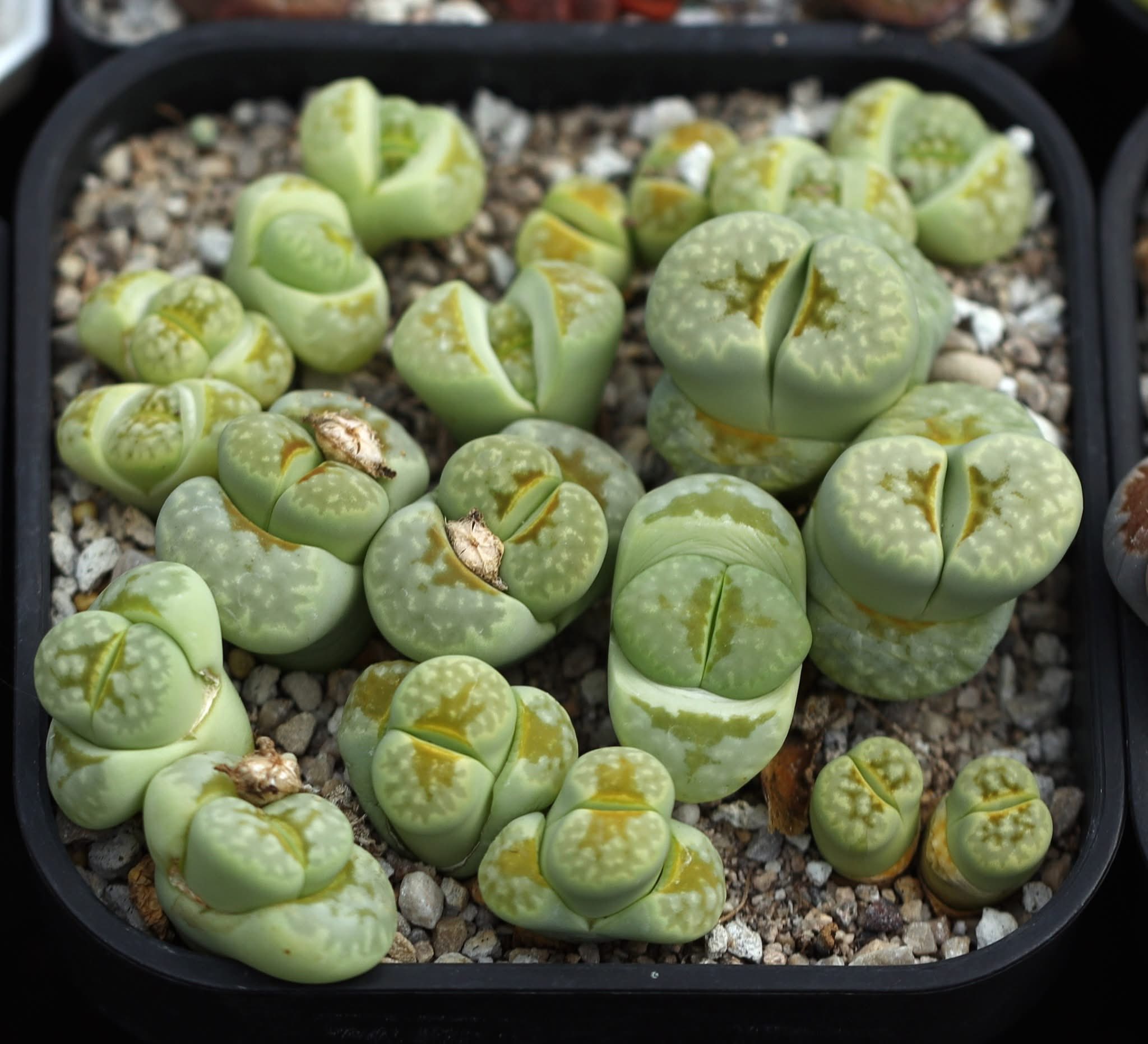
Body form is the standard Lithops architecture: a single pair of fused leaves forming a low cone or cylinder that sits flush with or slightly below the soil surface, with only the flat to slightly convex dorsal face exposed. Bodies are stemless. Mature dimensions run roughly 20–30 mm broad, 16–20 mm thick, with a fissure 5–12 mm deep separating the two leaves. Plants are typically solitary or form clumps of two to fifteen or more bodies in mature specimens.
Body colour and face pattern are highly variable across populations and across individuals within a single locality. The base colour runs from whitish-grey through pinkish-grey and yellowish-brown-grey to dark grey; older descriptions recognised three named pattern forms still used in the trade: pallid (pale milky grey, faint markings), reticulated (reddish-brown channel network on a pearly base), and fuscous (mottled milky grey overlaid with dark brown). Wild populations typically show all three intermingled. The dorsal face carries a network of raised or channelled lines forming a reticulated to dendritic pattern over the translucent window, and it is this network combined with the lip-smear that gives the species its collector-coveted ornamental character.
The diagnostic feature is the brown ‘lip-smear’: a marking along the inner margins of the fissure, occurring as either a narrow edging or a broader lining along the outer margins of the fissure walls. The intensity varies from faint edging in pallid individuals to heavy chocolate-brown in fuscous specimens. The lip-smear is taxonomically load-bearing: present in nominate julii, and absent or reduced to rust-brown lines mainly between the lobes in the South African fulleri populations. Flowers are white, daisy-form, actinomorphic, 20–30 mm in diameter, single per body, emerging from the central fissure in autumn. Flowers open in the early afternoon for 2–3 hours and the flowering event spans 4–7 days per body. Seed capsules carry yellow-brown to light yellow-brown seeds in the locule structure characteristic of the Aizoaceae.
Locality detail
The type locality of Lithops julii is recorded as halfway between Vahldoorn and Warmbad in the Karas Region of southern Namibia, on the Namibian side of the Orange River. The original collection was made by Kurt Dinter on his early twentieth-century Namibian collecting trips and the species was described first as Mesembryanthemum julii by Dinter & Schwantes in 1922. Brown transferred the species to Lithops in 1926, by which time the genus had been established for four years. The Karas Region sits on the elevated southern Namibian plateau between roughly 450 and 1,000 m, occupying the Nama Karoo biome at its Namibian extent.
The map above marks the type locality between Vahldoorn and Warmbad, four Cole-numbered nominate populations across the Warmbad-Karasburg belt, and two range-edge stocks. C063 and C205 are typical Warmbad-area localities; the C205 stock is the population formerly described as L. chrysocephala and now synonymised. C297 and C349 are the source populations for the cultivar ‘Peppermint Crème’ anthocyanin-pale selection. C215, C216, and C217 cover the var. rouxii stocks on the Namibian side of the Orange River, north of Vioolsdrif; these were the transitional populations that complicated the historical taxonomy and are now also synonymised under julii. The South African fulleri populations south of the Orange River are documented on the L. julii subsp. fulleri page rather than mapped here.
Lithops julii care and cultivation
Lithops julii is intermediate in difficulty: not as forgiving as the summer-rainfall L. lesliei, and not as demanding as the coastal fog-belt L. optica. The cultivation framework is the genus framework: 95% mineral substrate, the inverted seasonal calendar, full sun, dry winter cold. Most failures come from misplaced summer water during dormancy, which produces rot from the collar down within days in warm humid conditions, or from watering during the late-winter old-leaf transfer window, which starves the new pair and kills the plant from inside.
Substrate
The house mesemb formulation for julii is 33% pumice (3–5 mm), 12% lava rock (5–10 mm, structural drainage aggregate), 10% zeolite (clinoptilolite, 4–6 mm), 20% granite grit (3–5 mm), 0% limestone, 20% coarse silica grit (1–3 mm angular crystalline quartz), and 5% worm castings as the sole organic component. The 95/5 inorganic-to-organic ratio is the Lithops genus baseline, higher than the cactus-default 90/10 used elsewhere on this site, and holds at that class-prior figure because the named-grower sources on file for the genus disagree by more than the site’s resolution threshold. Limestone is omitted: no source reports a lime preference for julii or for the genus in either direction, and the zeolite already buffers the mix toward neutral. The lava fraction aerates the lower pot volume and supports fast drainage during the active autumn-winter season. Pot in unglazed terracotta or clay composite, 10–12 cm deep, never glazed ceramic; the porosity of unglazed clay accelerates drying and moderates temperature swings around the buried body.
All 16 Lithops on this site use one flat mineral formulation: the 95/5 mesemb baseline (95% inorganic, 5% organic), higher than the 90/10 cactus default used elsewhere on this site. No cultivation source at any tier distinguishes substrate practice between Lithops species, so every row below carries the same house formulation rather than sixteen separate findings. Silica sits at 20% and limestone at 0% as continuity conventions, not evidenced per-species figures.
| Species | Pumice | Lava | Zeolite | Granite | Limestone | Silica | Organic |
|---|---|---|---|---|---|---|---|
| L. lesliei | 33% | 12% | 10% | 20% | 0% | 20% | 5% |
| L. karasmontana | 33% | 12% | 10% | 20% | 0% | 20% | 5% |
| L. karasmontana subsp. bella | 33% | 12% | 10% | 20% | 0% | 20% | 5% |
| L. karasmontana subsp. amicorum | 33% | 12% | 10% | 20% | 0% | 20% | 5% |
| L. karasmontana ‘Top Red’ | 33% | 12% | 10% | 20% | 0% | 20% | 5% |
| L. burchellii | 33% | 12% | 10% | 20% | 0% | 20% | 5% |
| L. lesliei ‘Albinica’ | 33% | 12% | 10% | 20% | 0% | 20% | 5% |
| L. lesliei ‘Storm’s Albinigold’ | 33% | 12% | 10% | 20% | 0% | 20% | 5% |
| L. pseudotruncatella | 33% | 12% | 10% | 20% | 0% | 20% | 5% |
| L. dendritica | 33% | 12% | 10% | 20% | 0% | 20% | 5% |
| L. optica | 33% | 12% | 10% | 20% | 0% | 20% | 5% |
| L. optica ‘Rubra’ | 33% | 12% | 10% | 20% | 0% | 20% | 5% |
| L. aucampiae | 33% | 12% | 10% | 20% | 0% | 20% | 5% |
| L. aucampiae subsp. koelemanii | 33% | 12% | 10% | 20% | 0% | 20% | 5% |
| L. julii (this page) | 33% | 12% | 10% | 20% | 0% | 20% | 5% |
| L. julii subsp. fulleri | 33% | 12% | 10% | 20% | 0% | 20% | 5% |
Watering and light
The watering calendar is inverted relative to every cactus on this site. L. julii grows actively in the cool months and rests dry through summer. In Northern Hemisphere cultivation: full dormancy May through July (no water at all, wrinkled bodies are normal and not a watering signal), watch and wait through August (first light water at the end of the month if temperatures are clearly trending down), active watering September through November (water thoroughly to runoff, then let the mix dry completely over 10–14 days; this is the flowering window), tapered watering December through February (every 3–4 weeks maximum, and never while the old leaf pair is mid-transfer to the new pair), final water March or April, then stop. Six-month total dormancy is normal and survivable for healthy plants in a deep pot. Summer water is the leading killer of julii in cultivation; no exceptions, no top-ups.
Light requirements are the genus default: bright direct sun, minimum 5–6 hours daily for compact body shape and full lip-smear and face-pattern colour development. The Karas Region sun is the habitat baseline. A south-facing windowsill in the Northern Hemisphere is the indoor minimum; outdoor summer growing under shade cloth is preferred where climate allows. Plants under chronically low light etiolate, stretch their fissures, lose face contrast and lip-smear intensity, and split their skins on the next watering. The afternoon shade some sources recommend is intended for hot summer glass-greenhouse conditions to prevent overheating, not a general light reduction.
Cold tolerance and the leaf-pair cycle
The dry cold floor for cultivation is 5°C; documented tolerance to brief exposure at −7°C exists for the Cole-treatment subsp. fulleri when the body and substrate are bone dry, and the genus-level conservative dry floor of 2°C also applies in principle. A wet plant at any temperature near freezing is a dead plant. The danger is moisture, not cold. Keep the substrate dry from late autumn through the end of winter and the species rides out conditions harder than a typical European or North American grower has on offer. The species’ defining biological event is the annual leaf-pair replacement: the new pair grows inside the old one over winter, draws moisture and nutrient from it, and emerges in spring as the old pair desiccates to paper. Do not water while the old pair is mid-transfer. Watering during the January-February transfer window refills the old leaves, starves the new pair, and kills the plant from inside.
Comparison
Within the genus, the closest visual comparator to L. julii is Lithops karasmontana of the Karas Mountains further north in Namibia. Both species are grey-bodied, heavily patterned, and white-flowered; both occupy the southern Namibian sub-arid range. The single most reliable diagnostic character separating them is the lip-smear: present along the inner fissure walls in L. julii, absent in L. karasmontana. L. karasmontana carries deep red channels on a grey-brown face and is the stock from which the trade-defining L. karasmontana ‘Top Red’ selection is drawn. Pallid julii individuals occasionally approach the white (opalina) forms of karasmontana closely enough that field workers use the lip-smear as the deciding character.
Across the Orange River, the closest taxonomic sibling is L. julii subsp. fulleri as Cole treats the name (POWO synonymises). The Northern Cape fulleri populations between Kenhardt, Pofadder, and Upington grow on pegmatitic granite and calcrete rather than desert limestone, and the lip-smear is absent or reduced to rust-brown lines mainly between the lobes; the face pattern is generally paler and less reticulated than nominate julii. The dimensions and growth habit are otherwise close. Cultivation between the two is essentially identical, though the substrate calibration leans toward granite grit emphasis for fulleri populations rather than the limestone-tolerant nominate.
Within the broader genus, L. julii sits in the white-flowered western group with L. karasmontana and the coastal fog-belt Lithops optica. Yellow-flowered species such as the Highveld L. lesliei and the Khomas Plateau Lithops pseudotruncatella are immediately distinguished by flower colour. Red-purple anthocyanin-loaded selections such as L. optica ‘Rubra’ operate on a different visual register entirely. The lip-smear remains the single most reliable identification character when the species is encountered in cultivation alongside any of these.
Frequently asked questions
Is Lithops julii hard to grow?
Intermediate. The substrate is undemanding within the 95% mineral mesemb framework, but the species has a narrower tolerance for misplaced summer water than the more forgiving L. lesliei. The single hardest thing is the inverted seasonal calendar: Lithops grow in autumn and winter and rest dry through summer, the opposite of every cactus. Growers carrying their cactus watering instincts across to a Lithops pot kill plants in the first June. Once the calendar is internalised, L. julii rewards reliably with the diagnostic brown lip-smear and white autumn flowers; before that, expect rot on any plant given summer water.
Can Lithops julii be grown from seed?
Yes, and seed is the only standard propagation route for the species. Seeds germinate in 1–3 weeks at 20–25°C day with cooler nights around 10–15°C, surface-sown without cover on a moist mineral-dominant seedling mix. Time to first flower is 3–4 years under good cultivation with respected dormancy. Strong autumn light is specifically required for the white flowers to open fully; low-light conditions can produce buds that fail to open. Grafting is not standard practice for Lithops in the way it is for rare cacti; the buried-body morphology is incompatible with standard cactus grafting, and the genus is grown almost exclusively from seed in the global trade.
Is Lithops julii legal to own?
Yes, with no CITES paperwork. L. julii is not listed on any CITES appendix because the family Aizoaceae is not covered by the Cactaceae blanket Appendix-II listing; the no-CITES status is the load-bearing legal distinction between Lithops and most of the other rare succulents on this site. Wild collection in Namibia is governed by the Nature Conservation Ordinance 4 of 1975, administered by the Ministry of Environment, Forestry and Tourism; permits are required for collection of native plants regardless of specific Schedule 9 listing. Wild collection in South Africa for the Cole-treatment fulleri populations requires a TOPS permit under NEMBA (Act 10 of 2004) plus Northern Cape provincial conservation authorisation. Nursery-propagated material with documented seed-grown provenance is the legally and ethically defensible source for collector specimens worldwide; international trade in nursery stock is unrestricted by CITES.
Where does Lithops julii grow in the wild?
In southern Namibia, in the Warmbad-Karasburg belt of the Karas Region. The type locality is recorded as halfway between Vahldoorn and Warmbad. Cole-numbered populations range from approximately 25 km to 60 km southeast of Warmbad, with var. rouxii stocks 70–75 km west-southwest of Warmbad on the Namibian side of the Orange River. The Karas plateau elevation runs roughly 450 to 1,000 m. Habitat substrate is quartz pebbles over desert limestone, with white, grey, pink, red, and brown background colours that the body face mimics across its pallid, reticulated, and fuscous pattern forms. The Cole-treatment subsp. fulleri populations south of the Orange River in the Northern Cape are covered on their own page rather than counted as nominate range here.
When does Lithops julii flower?
Autumn. In Northern Hemisphere cultivation the flowering window runs October to November. Flowers are white, daisy-form, 20–30 mm in diameter, single per body, emerging from the central fissure between the two fused leaves. Individual flowers open in the early afternoon for 2–3 hours per day and the flowering event spans 4–7 days per body. White is the default colour and is the primary character separating L. julii from yellow-flowered species such as L. lesliei; the lip-smear separates it from the also-white-flowered L. karasmontana. Strong autumn light is required for buds to open fully; plants in marginal light may produce buds that fail to open.
Sources & further reading
Dinter, K. and Schwantes, M.H.G. (1922). Mesembryanthemum julii Dinter & Schwantes (basionym) · Brown, N.E. (1926). Lithops julii (Dinter & Schwantes) N.E.Br. Gardeners’ Chronicle Series III, 79: 102 · Kew POWO. Lithops julii (Dinter & Schwantes) N.E.Br., IPNI lsid urn:lsid:ipni.org:names:362450-1. powo.science.kew.org · IPNI. Lithops julii, urn:lsid:ipni.org:names:362450-1 · Cole, D.T. and Cole, N.A. (2005). Lithops: Flowering Stones (2nd ed.). Cactus & Co · llifle, Encyclopedia of Living Forms. Lithops julii (entry 13037) and L. julii subs. fulleri (entry 13045). llifle.com · SANBI Red List of South African Plants. Lithops julii subsp. fulleri Least Concern, assessed 2006 by P.M. Burgoyne. redlist.sanbi.org/species.php?species=85-112 · SANBI Sensitive Species List. Lithops julii subsp. fulleri var. brunnea. nssl.sanbi.org.za/node/3977 · travaldo.blogspot.com. Lithops julii (June 2019) · lithops.padstoel.nl. Lithops julii · World of Succulents. Lithops julii (Julius’s Living Stone). worldofsucculents.com · Namibia Nature Conservation Ordinance 4 of 1975 (Schedule 9 Protected Plants framework). faolex.fao.org/docs/pdf/nam18007.pdf · South Africa National Environmental Management: Biodiversity Act (NEMBA, Act 10 of 2004) and TOPS Regulations (2007). dffe.gov.za · Wikipedia. Lithops; Lithops julii. en.wikipedia.org