
Lithops karasmontana
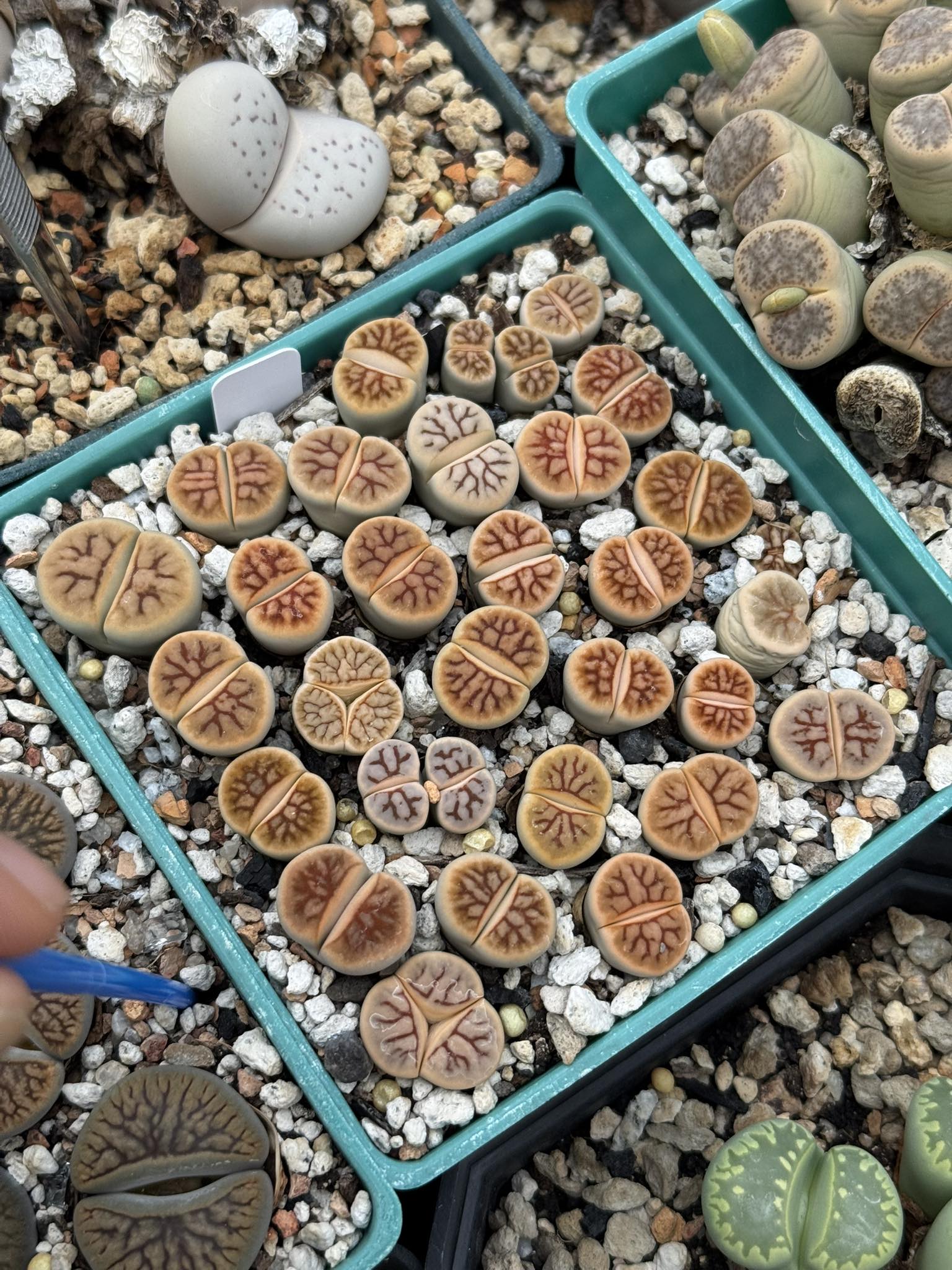
Lithops karasmontana (Dinter & Schwantes) N.E.Br. is the Karas Mountains living stone of southern Namibia, named for the Great Karasberg plateau where Kurt Dinter collected the type specimen in the early twentieth century. Dinter and Schwantes published the basionym Mesembryanthemum karasmontanum in Monatsschrift für Kakteenkunde 30: 36 in 1920; Nicholas Edward Brown transferred the species to his new genus Lithops in 1926, in the same period during which he was establishing the living-stones genus as separate from the catch-all Mesembryanthemum. The epithet karasmontana compounds the Khoekhoegowab toponym Karas with the Latin montana, simply ‘of the Karas Mountains’.
The species is a Namibian endemic of the ǁKaras Region, the southernmost administrative region of the country, with populations clustering around Grünau and Karasburg and extending into the Great Karasberg plateau. Plants grow flush with quartzite gravel and rocky upland slopes between roughly 900 and 1,600 metres elevation, where winter rainfall and summer dryness drive the cool-season growth and summer dormancy that define the genus. The Karasberg plateau experiences genuine overnight frost in winter; this is among the most cold-experienced species in the genus, and the cold tolerance carries through to cultivation provided the plants are bone dry through the cold months.
Among the taxa covered on this site, the nominate L. karasmontana sits alongside three other POWO-recognised subspecies and the trade-defining L. karasmontana ‘Top Red’ cultivar, the brick-red-channelled selection that has dominated Lithops collections for two generations. The L. karasmontana subsp. bella and L. karasmontana subsp. amicorum siblings are treated on their own pages; the white-flowered Namibian sibling Lithops julii is the next-most-encountered species in the trade and the natural cross-comparison for the karasmontana complex.
Bodies are grey-brown to pinkish-grey to reddish-brown depending on locality form, light, and seasonal hydration, with a kidney-shaped dorsal face traversed by a network of channelled deep red to dark reddish-brown lines that resolve the species to genus-and-species at a glance. Flowers are satiny white, narrow-rayed, daisy-form, around 30 to 35 mm across, and emerge from the central fissure between the two fused leaves in October and November in Northern Hemisphere cultivation. The white flower colour separates the species from the yellow-flowered Lithops lesliei, the type species of the genus, and aligns it with the white complex that includes L. julii and L. optica.
Lithops karasmontana quick reference
A Namibian Karas Mountains mesemb that grows actively in the cool months and rests dry through summer; the calendar is inverted relative to every cactus on this site. Values calibrated for seed grown plants in cultivation, drawn from L. karasmontana habitat data and grower consensus across multiple specialist Lithops sources rather than genus-level extrapolation.
Taxonomy & nomenclature
The accepted name is Lithops karasmontana (Dinter & Schwantes) N.E.Br., with the basionym Mesembryanthemum karasmontanum Dinter & Schwantes published in Monatsschrift für Kakteenkunde 30: 36 (1920). Kurt Dinter, the prolific Namibian field botanist, collected the type specimen in the Great Karas Mountains; Moritz August Schwantes co-authored the formal description. Nicholas Edward Brown transferred the taxon to his new genus Lithops in 1926, publishing the combination in Gardeners’ Chronicle Series III, 79: 102 (1926). Kew POWO carries the 1926 combination as the current accepted name (IPNI lsid urn:lsid:ipni.org:names:362452-1).
POWO recognises four subspecies of L. karasmontana: the nominate; subsp. amicorum (D.T.Cole) Loots & Ritz, formerly treated as the full species Lithops amicorum D.T.Cole and elevated to subspecific rank by Loots and Ritz on molecular grounds; subsp. bella (N.E.Br.) D.T.Cole, the beige-bodied larger-windowed clumping form first described by Brown and reduced to subspecific rank by Cole; and subsp. eberlanzii, the dark-windowed form with greenish-white ridges. The status of subsp. bella and subsp. eberlanzii is not stable across the literature: one paper raises both to species rank on seed morphology grounds, and POWO’s current treatment should be checked at build time for any sibling-page work. All four subspecies are sold under their Cole-treatment names in the trade and have their own slugs in the on-site taxa list.
Within the nominate subspecies, llifle and Cole’s field-number system document several varieties below the level of the on-site taxa list: var. aiaisensis, var. lericheana, and var. tischeri. These are infra-subspecific taxa traded under their var. names with C-number provenance (var. tischeri C182 from 30 km NNE of Grünau, var. lericheana C193 from the same area, var. lericheana C329 and C330 from 70 km north of Karasburg) but do not require separate specimen pages. The Mickberg-area populations near Grünau (C168, C169, C327, C328) were originally circulated as Lithops mickbergensis, now treated by Cole as a synonym of the nominate subspecies. The trade-defining cultivar ‘Top Red’, with its brick-red channelled face-lines, has its own page on this site and carries the full provenance detail.
Historical synonyms (4)
- Lithops erniana var. aiaisensis DeBoer, heterotypic synonym
- Lithops erniana var. witputzensis DeBoer, heterotypic synonym
- Lithops jacobseniana Schwantes ex Jacobsen, heterotypic synonym
- Lithops ursulae Swüste, heterotypic synonym
Sources: POWO (Kew) · IPNI · GBIF · Wikidata
Habitat
Lithops karasmontana is a Namibian endemic of the ǁKaras Region, the southernmost administrative region of the country, named for the same Karas Mountains as the species. Populations cluster on the west and south-west of the Great Karasberg plateau, between Klein Karas, Grünau, Karasburg, and the Ai-Ais hot springs area, with the type locality in the Great Karas Mountains themselves. The closely related subspecies bella reaches near Aus, and subsp. eberlanzii extends to Aus and the Sperrgebiet fringe; the nominate subspecies sits east of these and is the Karasburg-and-Grünau-belt taxon.
Elevation runs roughly 900 to 1,600 metres across the documented populations, with Grünau itself at approximately 900 m and the Great Karasberg plateau rising above 1,600 m to a maximum summit elevation of 2,206 m at Mt. Schroffenstein. Climate is arid to semi-arid continental: hot dry summers regularly exceeding 35°C at lower elevations, cold clear winters with frost on the plateau. The Karas Region receives predominantly winter rainfall supplemented by summer thunderstorms, with annual precipitation at Grünau averaging 150 to 200 mm and concentrated in the cooler months from April through September. This places the species firmly in the winter-rainfall zone and aligns it with the autumn-active cultivation calendar that defines the genus.
Substrate is quartzite-dominated gravel and rocky outcrop. Plants grow flush with the surrounding quartzite chips, almost entirely buried with only the dorsal face exposed, in a textbook demonstration of the Lithops mimicry strategy. Quartzite is the dominant parent rock of the Great Karasberg region, and the substrate runs siliceous rather than calcareous; no calcareous adjustment to the standard 95/5 mineral mesemb mix is required for cultivation. Associated mesemb genera in the same quartz-field microhabitat across southern Namibia and adjacent Northern Cape include Conophytum, Argyroderma, Dinteranthus, and Lapidaria; these are the natural ecological neighbours of L. karasmontana and all share the same drainage and substrate requirements in cultivation.
Morphology
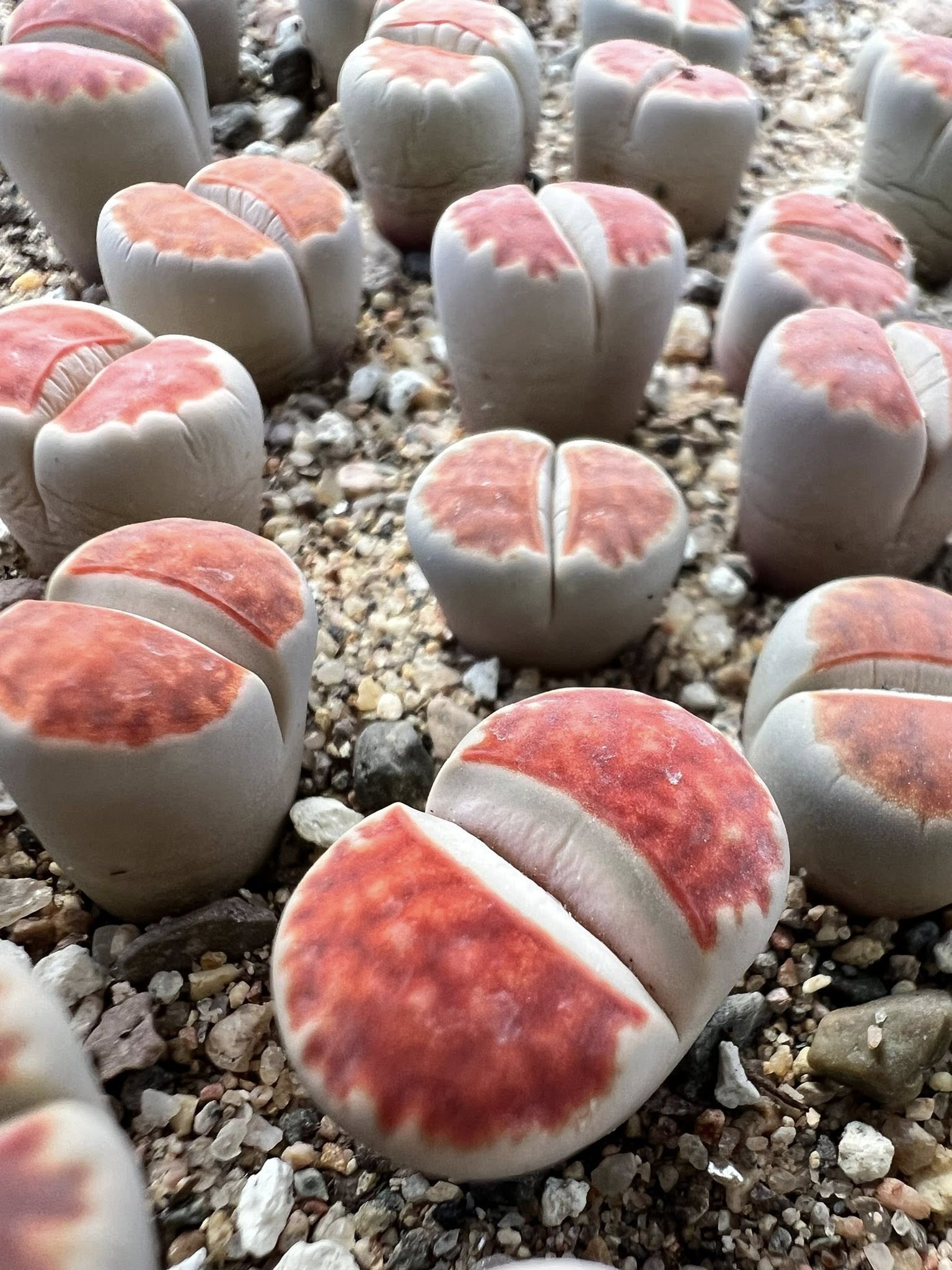
Body form is the standard Lithops architecture: a single pair of massively thickened, fused leaves forming a cleft obconic body buried flush with the soil surface, with only the flat to slightly convex dorsal face exposed. The plant is essentially stemless. L. karasmontana bodies reach roughly 4 cm tall above the soil surface in mature specimens, with the kidney-shaped dorsal face up to 35 mm long and 28 mm wide. Mature plants typically form clumps of 2 to 6 heads in cultivation, with rare specimens reaching 12 or more heads over many years; the closely related subsp. bella clumps far more freely, sometimes producing stands of 60 heads.
Face colour and pattern are the diagnostic characters and the source of the locality forms documented in the Cole field-number system. Ground colour runs from light grey through grey-brown, brownish-grey, light yellowish-brown, to reddish-brown depending on locality, light intensity, and seasonal hydration; the base body is typically pinkish-grey to warm grey. Across the dorsal face lies a network of branching, channelled deep red to dark reddish-brown lines, often described as channel marks or as lobed kidney-shaped figures framing the window margins. The Signalberg Form (C065) from 25 km WNW of Grünau carries the ‘blurred red marks’ documented on llifle, and the trade-defining cultivar ‘Top Red’ is selected for the brightest brick-red channels. The translucent window itself is separated from the body margin by a buffer zone of paler colouration, and admits filtered light to the chlorophyll-packed tissue inside the buried body.
Flowers are satiny white, narrow-rayed, daisy-form, between 25 and 45 mm in diameter and most often around 30 to 35 mm, single per body, emerging from the central fissure between the two fused leaves in autumn. White is the species’s default flower colour and is shared across the entire karasmontana complex (nominate plus all four subspecies). Flowering peaks in October and November in Northern Hemisphere cultivation, with one source citing early November as the typical peak; in Southern Hemisphere habitat the corresponding window runs roughly March through May. Flowers carry a sweet, spicy fragrance that attracts bees, the primary pollinator of the genus; the plant is not self-fertile and requires cross-pollination from a separate L. karasmontana individual to set seed. Seed capsules are typically five-chambered, occasionally four or six. Compare the white flower colour against the yellow flowers of Lithops lesliei and the red-purple windows of Lithops optica to place the species in its genus context.
Locality detail
The type locality of Lithops karasmontana is the Great Karas Mountains of southern Namibia, where Kurt Dinter collected the specimen on which Dinter and Schwantes based the 1920 publication of Mesembryanthemum karasmontanum. The Great Karasberg plateau, often spelled Groot Karasberge in Afrikaans, rises above 1,600 m on the southern Namibian highveld and reaches a maximum summit elevation of 2,206 m at Mt. Schroffenstein. The species is restricted to the ǁKaras Region of Namibia, with no records from South Africa for the nominate subspecies.
The map above marks the type locality on the Great Karasberg plateau, four locality forms within the nominate subspecies documented in the Cole field-number system, and the western range edge near Ai-Ais where the nominate meets the neighbouring subspecies. The Mickberg-area populations 10 to 20 km NNE of Grünau (C168, C169, C327, C328) are the source of the Lithops mickbergensis trade name now synonymised under the nominate subspecies by Cole. The Signalberg Form (C065) sits 25 km WNW of Grünau and carries the blurred-channel face pattern documented on llifle. The infra-subspecific varieties tischeri (C182, 30 km NNE of Grünau) and lericheana (C193 in the same area, plus C329 and C330 70 km north of Karasburg) are traded under their var. names but sit below the level of the on-site taxa list. No precise published population count for the species was located in the research underlying this page.
Lithops karasmontana care and cultivation
Lithops karasmontana sits in the intermediate tier of Lithops cultivation difficulty: the species germinates readily, is widely sold, and rewards correct calendar discipline with reliable autumn flowering from year four onwards. The principal failure mode is summer watering, which causes rapid crown rot regardless of how well-prepared the substrate is; the second danger window is watering while the old leaf pair is mid-transfer to the new pair in January and February. The cultivation framework is the genus mesemb framework: 95% mineral substrate, the inverted seasonal calendar, full sun, and dry winter cold.
Substrate
The house mesemb formulation for karasmontana is 33% pumice (3–5 mm), 12% lava rock (5–10 mm, structural drainage aggregate), 10% zeolite (clinoptilolite, 4–6 mm), 20% granite grit (3–5 mm), 0% limestone, 20% coarse silica grit (1–3 mm angular crystalline quartz), and 5% worm castings as the sole organic component. The 95/5 inorganic-to-organic ratio is the Lithops genus baseline, higher than the cactus-default 90/10 used elsewhere on this site; it is a class-prior default rather than a per-species finding, since the named-grower sources on file for the genus disagree by more than the site’s resolution threshold. Silica sits at 20 per cent and limestone at 0 per cent as house continuity figures: no published source names a grit material, a proportion, or a lime preference specific to this species. The zeolite buffers the mix toward neutral pH and the lava fraction aerates the lower pot volume during the active autumn-winter season. Pot in unglazed terracotta or clay composite, 10–12 cm deep, never glazed ceramic; the porosity of unglazed clay accelerates drying and moderates temperature swings around the buried body.
All 16 Lithops on this site use one flat mineral formulation: the 95/5 mesemb baseline (95% inorganic, 5% organic), higher than the 90/10 cactus default used elsewhere on this site. No cultivation source at any tier distinguishes substrate practice between Lithops species, so every row below carries the same house formulation rather than sixteen separate findings. Silica sits at 20% and limestone at 0% as continuity conventions, not evidenced per-species figures.
| Species | Pumice | Lava | Zeolite | Granite | Limestone | Silica | Organic |
|---|---|---|---|---|---|---|---|
| L. lesliei | 33% | 12% | 10% | 20% | 0% | 20% | 5% |
| L. karasmontana (this page) | 33% | 12% | 10% | 20% | 0% | 20% | 5% |
| L. karasmontana subsp. bella | 33% | 12% | 10% | 20% | 0% | 20% | 5% |
| L. karasmontana subsp. amicorum | 33% | 12% | 10% | 20% | 0% | 20% | 5% |
| L. karasmontana ‘Top Red’ | 33% | 12% | 10% | 20% | 0% | 20% | 5% |
| L. burchellii | 33% | 12% | 10% | 20% | 0% | 20% | 5% |
| L. lesliei ‘Albinica’ | 33% | 12% | 10% | 20% | 0% | 20% | 5% |
| L. lesliei ‘Storm’s Albinigold’ | 33% | 12% | 10% | 20% | 0% | 20% | 5% |
| L. pseudotruncatella | 33% | 12% | 10% | 20% | 0% | 20% | 5% |
| L. dendritica | 33% | 12% | 10% | 20% | 0% | 20% | 5% |
| L. optica | 33% | 12% | 10% | 20% | 0% | 20% | 5% |
| L. optica ‘Rubra’ | 33% | 12% | 10% | 20% | 0% | 20% | 5% |
| L. aucampiae | 33% | 12% | 10% | 20% | 0% | 20% | 5% |
| L. aucampiae subsp. koelemanii | 33% | 12% | 10% | 20% | 0% | 20% | 5% |
| L. julii | 33% | 12% | 10% | 20% | 0% | 20% | 5% |
| L. julii subsp. fulleri | 33% | 12% | 10% | 20% | 0% | 20% | 5% |
Watering and light
The watering calendar is inverted relative to every cactus on this site. L. karasmontana grows actively in the cool months and rests dry through summer. In Northern Hemisphere cultivation: full dormancy May through July (no water at all, wrinkled bodies are normal and not a watering signal), watch and wait through August (first light water at the end of the month if temperatures are clearly trending down and the new leaf pair is visibly emerging in the fissure), active watering September through November (water thoroughly to runoff, then let the mix dry completely over 10 to 14 days; this is the flowering window), tapered watering December through February (every 3 to 4 weeks maximum, and never while the old leaf pair is mid-transfer to the new pair), final water March or April, then stop. Three months of total dormancy is the minimum; four months is acceptable for large firm-bodied specimens in deep pots.
Light requirements are the genus default: bright direct sun, minimum 5 to 6 hours daily for compact body shape and saturated red face-channel colour. Karasberg insolation is the habitat baseline. A south-facing windowsill in the Northern Hemisphere is the indoor minimum; outdoor summer growing under unglazed glass or 30–40% shade cloth is preferred where climate allows. Plants under chronically low light etiolate, stretch their fissures, lose the deep red channel contrast, and split their skins on the next watering. The summer dormancy requirement is light-independent: bright sun through summer is fine provided the substrate is bone dry.
Cold tolerance and the leaf-pair cycle
The dry cold floor for cultivation is −3°C; the Karasberg plateau above 1,600 m delivers genuine overnight frost in winter, which the plant survives only because it is bone dry across the cold months. A wet plant at any temperature near freezing is a dead plant. The danger is moisture, not cold. Keep the substrate dry from late autumn through the end of winter and the species rides out conditions far harder than anything a typical European or North American grower has on offer. The species’s defining biological event is the annual leaf-pair replacement: the new pair grows inside the old one over winter, draws moisture and nutrient from it, and emerges in spring as the old pair desiccates to paper. Do not water while the old pair is mid-transfer. Watering during the January-February transfer window refills the old leaves, starves the new pair, and kills the plant from inside.
Comparison
Within the karasmontana complex, the closest comparisons are the three sibling subspecies. Subsp. bella carries a uniform beige colouring with darker windows and a pellucid transparent window, and forms much larger clumps than the nominate, sometimes reaching 60 heads in cultivation. Subsp. eberlanzii has an opaque dark green window at or below the margin level with greenish-white ridges that merge with a wavy surface, blending window and lacinae together. Subsp. amicorum, formerly the full species L. amicorum, has a yellowish-green to grey-green body with brownish markings and a confirmed Namibian distribution from the Fish River Canyon area. The nominate subspecies sits between these in face character: grey-brown body with deep red channel marks, the most-traded face pattern in the complex.
Across the broader genus, the white flower colour aligns L. karasmontana with L. julii and the Sperrgebiet-endemic L. optica, and separates it from the yellow-flowered L. lesliei type species, Lithops aucampiae, and Lithops pseudotruncatella. L. julii carries an intricate red-brown lip-smear face pattern that contrasts with the channelled lines of karasmontana; L. optica is the coastal fog-belt extreme of the genus, frost-free in habitat, flowering after the winter solstice rather than in autumn, and IUCN Critically Endangered. L. karasmontana sits in the middle of the cultivation difficulty range: more demanding than lesliei, less demanding than optica.
The trade-defining L. karasmontana ‘Top Red’ cultivar is the brick-red-channelled selection that has dominated Lithops collections for decades; it runs on the same care calendar as the wild-type nominate subspecies but carries a much brighter red on the face pattern under good light. The infra-subspecific varieties documented in the Cole field-number system (var. aiaisensis, var. lericheana, var. tischeri) are traded under their var. names with C-number provenance but sit below the level of the on-site taxa list and share the standard nominate-subspecies cultivation profile.
Frequently asked questions
Is Lithops karasmontana hard to grow?
Intermediate. The species germinates readily and is widely sold, but the inverted Lithops calendar makes it less forgiving than L. lesliei. The single hardest thing is summer watering: a Lithops watered in June or July will rot from the crown within days, and cactus-trained growers carrying their summer watering instincts across to a Lithops pot lose plants in the first year. The second hardest thing is watering while the old leaf pair is mid-transfer to the new pair in January and February, which refills the old leaves and starves the new pair. Growers fluent in the inverted Lithops calendar handle karasmontana without difficulty; the species rewards calendar discipline with reliable autumn flowering from year four onwards.
Can Lithops karasmontana be grown from seed?
Yes, and seed is the only standard propagation route for the species. Seeds germinate in 4 to 7 days at 20–28°C day with cooler nights around 10–15°C, surface-sown on a finer-graded version of the 95/5 mineral mix and covered with a thin layer of fine sand or quartzite grit. Light is essential from day one. Seedlings look like tiny green rounded buttons for the first year and take their first leaf-pair replacement in the second year; they can be transplanted into individual pots after the first replacement is complete. Time to first flower is 3 to 4 years under good cultivation with respected dormancy. Grafting is not standard practice for Lithops; the genus is grown almost exclusively from seed in the global trade, and grafted Lithops are essentially unknown in collector circles.
Is Lithops karasmontana legal to own?
Yes, with no CITES paperwork. L. karasmontana is not listed on any CITES appendix because the family Aizoaceae is not covered by the Cactaceae blanket Appendix II listing; the no-CITES status is the load-bearing legal distinction between Lithops and most of the other rare succulents on this site. Wild collection inside Namibia requires a permit under the Nature Conservation Ordinance 4 of 1975 from the Ministry of Environment, Forestry and Tourism; Section 75 provides that licensed nurseries may sell and export protected plants without an individual collector permit. Nursery-propagated material with documented seed-grown provenance from established sources such as Köhres, Mesa Garden, and specialist Lithops nurseries is the legally and ethically defensible source for collector specimens worldwide; international trade in nursery stock is unrestricted by CITES.
Where does Lithops karasmontana grow in the wild?
In southern Namibia only. The species is a Namibian endemic of the ǁKaras Region, with populations clustering on the west and south-west of the Great Karasberg plateau between Klein Karas, Grünau, Karasburg, and the Ai-Ais hot springs area. The type locality is in the Great Karas Mountains themselves. Elevation runs roughly 900 to 1,600 metres, with Grünau at approximately 900 m and the Karasberg plateau rising above 1,600 m to a maximum summit of 2,206 m at Mt. Schroffenstein. Habitat is quartzite gravel plains and rocky mountain slopes, with plants growing flush with the surrounding quartzite chips in textbook mimicry. The Karas Region receives predominantly winter rainfall (150 to 200 mm annually at Grünau) supplemented by summer thunderstorms, with genuine overnight frost on the plateau in winter.
When does Lithops karasmontana flower?
Autumn. In Northern Hemisphere cultivation the flowering window runs October to November, with one source citing early November as the typical peak; the corresponding Southern Hemisphere habitat window runs roughly March through May. Flowers are satiny white, narrow-rayed, daisy-form, between 25 and 45 mm in diameter and most often around 30 to 35 mm, single per body, emerging from the central fissure between the two fused leaves. White is the species’s default flower colour and is shared across the entire karasmontana complex. Flowers carry a sweet, spicy fragrance attractive to bees; the plant is not self-fertile and requires cross-pollination from a separate L. karasmontana individual to set seed. First flower from seed comes at 3 to 4 years under good cultivation.
Sources & further reading
Brown, N.E. (1926). Lithops karasmontana (Dinter & Schwantes) N.E.Br. Gardeners’ Chronicle Series III, 79: 102 · Dinter, K. and Schwantes, M.A. (1920). Mesembryanthemum karasmontanum (basionym). Monatsschrift für Kakteenkunde 30: 36 · Kew POWO. Lithops karasmontana (Dinter & Schwantes) N.E.Br., IPNI lsid urn:lsid:ipni.org:names:362452-1. powo.science.kew.org · Kew POWO. Lithops karasmontana subsp. amicorum (D.T.Cole) Loots & Ritz. powo.science.kew.org/taxon/77203975-1 · Kew POWO. Lithops karasmontana subsp. bella (N.E.Br.) D.T.Cole. powo.science.kew.org/taxon/954647-1 · GBIF. Lithops karasmontana (Dinter & Schwantes) N.E.Br. occurrence dataset. gbif.org/species/7329209 · World Flora Online. Lithops karasmontana, wfo-0001293540. worldfloraonline.org · Cole, D.T. and Cole, N.A. (2005). Lithops: Flowering Stones (2nd ed.). Cactus & Co · llifle, Encyclopedia of Living Forms. Lithops karasmontana and locality entries C065 (Signalberg Form), C168, C169, C226, C327, C328 around Grünau. llifle.com · World of Succulents. Lithops karasmontana (Karas Mountains Living Stone). worldofsucculents.com · Loots, S. (2019). Habitat characteristics, genetic diversity and conservation of the genus Lithops. SLU Epsilon thesis. pub.epsilon.slu.se · Namibia Nature Conservation Ordinance 4 of 1975. FAO Lex (faolex.fao.org) and Legal Assistance Centre (lac.org.na) · Mediterranean Garden Society. Lithops Cultivation. mediterraneangardensociety.org · Lithops Blog. Growing Lithops from seed. lithopsblog.wordpress.com · Wikipedia. Lithops karasmontana; Great Karas Mountains. en.wikipedia.org