
Blossfeldia
Blossfeldia Species & Types
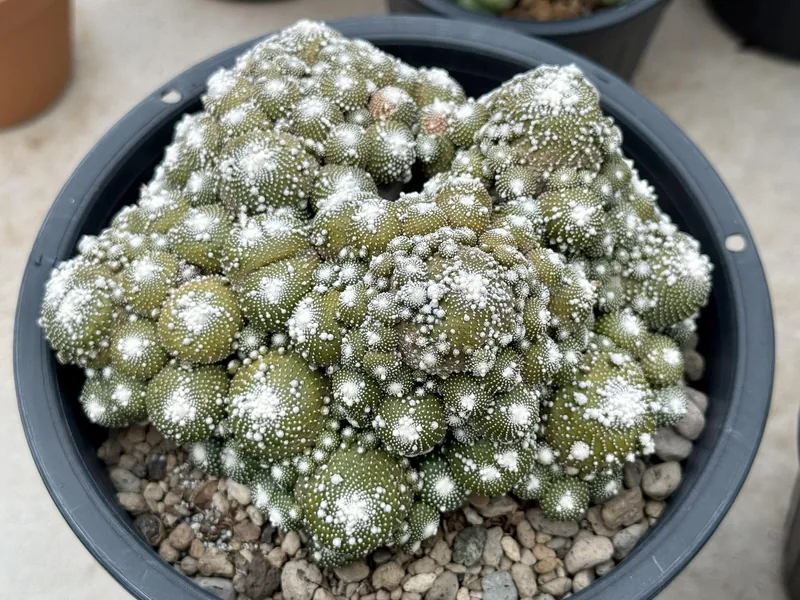
What is Blossfeldia and what makes it unique among cacti?
Blossfeldia is a monotypic South American genus holding a single species, Blossfeldia liliputana, which is the smallest cactus in the world. A mature body is only about 10 to 12 mm across, flat and button-shaped, grey-green, and completely without ribs, spines or tubercles, which is unlike almost every other cactus. Two traits set it further apart. It is nearly astomatous, carrying very few of the pores other plants breathe through, and it is poikilohydric: it can dry down to a fraction of its water content, shrink into a rock crevice, and revive when moisture returns, a desiccation tolerance no other cactus matches. On that combination of characters Blossfeldia is placed in its own tribe, Blossfeldieae, sister to the rest of the subfamily Cactoideae.
Where does Blossfeldia grow in the wild?
Blossfeldia grows in the dry Andes, from northwest Argentina through the provinces of Salta, Jujuy, Catamarca and Tucumán north into southern Bolivia. It is a rock-crevice specialist rather than a ground plant, rooting into cracks and seams on near-vertical cliff faces and boulders, very often close to seeps, spray or seasonal waterfalls that wet the rock. Recorded elevations run from around 1,200 m to well above 3,000 m. Wedged flush into the stone and often shrunk below the surface in drought, the plants are easy to overlook even where they are locally common.
How big does Blossfeldia get?
Blossfeldia stays tiny for its whole life. A single head reaches only about 10 to 12 mm in diameter, occasionally a little more, and sits nearly flush with the rock. What grows is the count, not the size: older plants offset freely from the base and build low clustered cushions of many small heads packed together in a crevice. Below that modest body sits a comparatively large tuberous root that anchors the plant in the crack and stores water, so most of a mature Blossfeldia is out of sight.
What do Blossfeldia flowers look like?
Blossfeldia flowers are small and pale, in keeping with the plant. Each bloom is roughly 5 to 9 mm across, white to faintly cream or pink, opening at the top of the body from felted areoles near the centre. The species is self-fertile and sets seed readily on its own, producing tiny fruits filled with dust-fine seed. In habitat that seed is spread by ants, which carry it deeper into the rock cracks where the next generation can establish, part of how a plant this small colonises sheer cliff faces.
How cold-hardy is Blossfeldia?
Blossfeldia is best treated as frost-tender despite its high-altitude home, and should be kept above about 5°C in cultivation. In habitat the plant rides out Andean cold by drying down hard and shrinking into the rock, but that trick depends on being bone dry, and a watered plant in a pot has none of that protection. Keep it dry through winter and frost-free, and give it a cool, bright rest rather than warm wet conditions, which invite rot in a plant adapted to spare, well-drained crevices.
What soil does Blossfeldia need in cultivation?
Blossfeldia needs an extremely lean, sharply draining mineral soil, because in the wild it roots in bare rock rather than earth. A mix built almost entirely from grit such as pumice, lava and crushed granite, with only a trace of organic matter and a coarse mineral top dressing, suits it best, and the pot must dry out fast between waterings. There is a practical wrinkle worth knowing: Blossfeldia is notoriously slow and rot-prone when grown ungrafted, and because of that most plants in cultivation are grafted onto a vigorous rootstock, which sidesteps the soil problem while the grower keeps the graft dry and bright.
Is Blossfeldia legal to own?
Yes, Blossfeldia is legal to own. No permit is needed to keep nursery-propagated plants within a country. Blossfeldia is covered by the Cactaceae family-wide CITES Appendix II listing that has been in force since 1975, so nursery-propagated plants are legal to buy, sell and grow, with permits needed only to move plants across international borders; seed is exempt under the standard cactus annotation. The species has never been separately uplisted to Appendix I. At rarecactus.com we raise our Blossfeldia from seed in our own greenhouse and keep its wild locality on record, so the fragile cushions wedged into their Andean cliffs are never stripped to fill an order.
Why is Blossfeldia so difficult and so prized?
Blossfeldia is prized precisely because it is hard, and because it is a botanical one-off. Its seed is close to dust and its seedlings are minute and slow, so raising the world’s smallest cactus to size ungrafted tests any grower’s patience, and rot is a constant risk in the wet. Yet the plant sits alone at the base of its subfamily, the only cactus that can dry down and revive like a resurrection plant, so a well-grown clustered cushion carries real scientific cachet. Note the spelling: the accepted epithet is liliputana, though the variant liliputiana is widely seen in the trade.