
Echinocereus
Known Species


What is Echinocereus and what makes it different from other cacti?
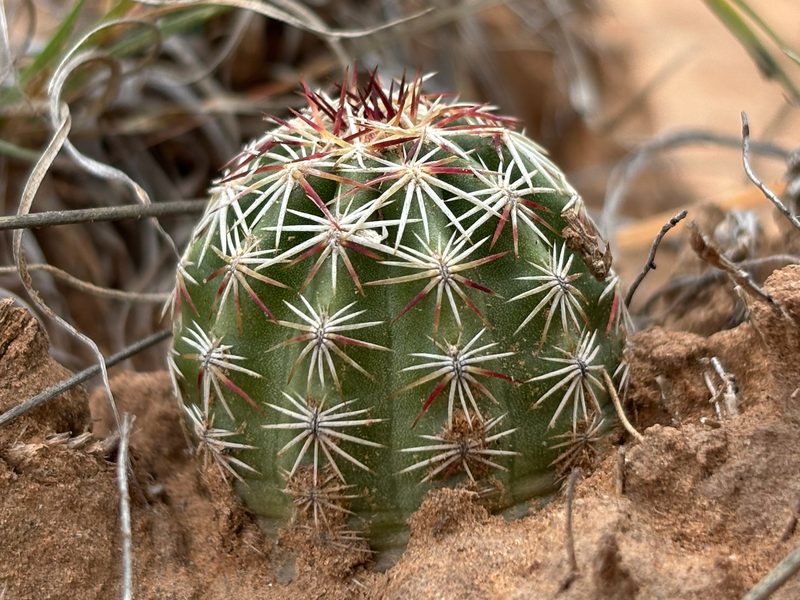
Echinocereus is a genus of about 85 species (Kew POWO) ranging from the southwestern United States through central Mexico. The genus has one diagnostic character: flower buds develop inside the stem and break out through the side of the plant rather than emerging from the apex. This erumpent flowering, paired with the compact ribbed body, persistent spiny fruit, and green stigma inside each flower, separates Echinocereus from Mammillaria (axillary flowers in a ring near the tip), Ferocactus (apical flowers on a barrel body), and Echinopsis (nocturnal flowers on a long floral tube).
Where does Echinocereus grow in the wild?
The genus spans an unusually wide geographic and climatic range for a cactus genus its size. The northern limit is the shortgrass prairie of South Dakota and Wyoming, where E. viridiflorus survives winters down to −20°C. The southern limit reaches central Mexican states including Guanajuato, San Luis Potosí, and Oaxaca. Elevation runs from near sea level in Sonoran Desert bajadas up to approximately 3,000 m in pine-oak and conifer woodland on the Sierra Madre. The genus is absent from South America.
How big does Echinocereus get?
Most Echinocereus stay compact: 10 to 30 cm tall and 5 to 15 cm in diameter. Clumping species such as E. triglochidiatus can build mounds of 100 or more stems over decades, but each individual stem rarely exceeds 45 cm in height. None of the launch species form a single massive barrel like Ferocactus; the genus tops out at the scale of a small football, not a wine barrel.
What do Echinocereus flowers look like?
Flowers are large (4 to 12 cm across), diurnal, and persist for two to five days, an unusually long bloom for the cactus family. Colour ranges from scarlet and crimson in E. triglochidiatus (hummingbird-pollinated) through magenta and rose-pink in E. pectinatus and E. rigidissimus to a soft yellow-green in E. viridiflorus, which is also the only species in the launch set with a noticeable lemon scent. The green stigma inside each flower is a genus-wide diagnostic.
How cold-hardy is Echinocereus?
Cold tolerance varies dramatically across the genus and is the single most important per-species fact for a grower. The US plains and intermountain species, E. viridiflorus and E. triglochidiatus, survive winters of −20°C and colder when kept dry, and hardened northern-provenance plants are grown in the ground in USDA zone 4 and 5 gardens. The Sonoran and Mexican highland species, E. rigidissimus, E. pectinatus, and E. knippelianus, tolerate −5 to −12°C and need protection from hard frosts. Wet cold at any temperature kills most species; dry cold is what the genus is adapted to handle.
What substrate does Echinocereus need in cultivation?
The genus needs a fast-draining mineral mix in the 90 to 10 inorganic to organic range. The genus baseline used on this site is 40% pumice, 20% lava rock, 15% granite grit, 10% zeolite, 5% silica, and 10% worm castings. Per-species adjustments matter: limestone-endemic species (E. pectinatus, E. knippelianus) take a 5 to 10% crushed limestone supplement, while strict calcifuges (E. rigidissimus) want the zeolite removed and the granite raised to push the mix toward acidity. The substrate should drain completely within 30 minutes of watering.
Is Echinocereus legal to own?
Echinocereus is listed under CITES Appendix II as part of the blanket Cactaceae family listing, so cross-border movement of plants requires CITES paperwork. Species-level US federal protection applies only to E. triglochidiatus var. arizonicus (US Endangered Species Act, listed 1979) and E. viridiflorus var. davisii (ESA Endangered, single-site Texas endemic on private ranch land). Nursery-propagated plants of the broadly traded forms are legal to buy, sell, and grow in the United States, the United Kingdom, Canada, the European Union, and Australia.
Why is the rainbow cactus, E. rigidissimus, so famous?
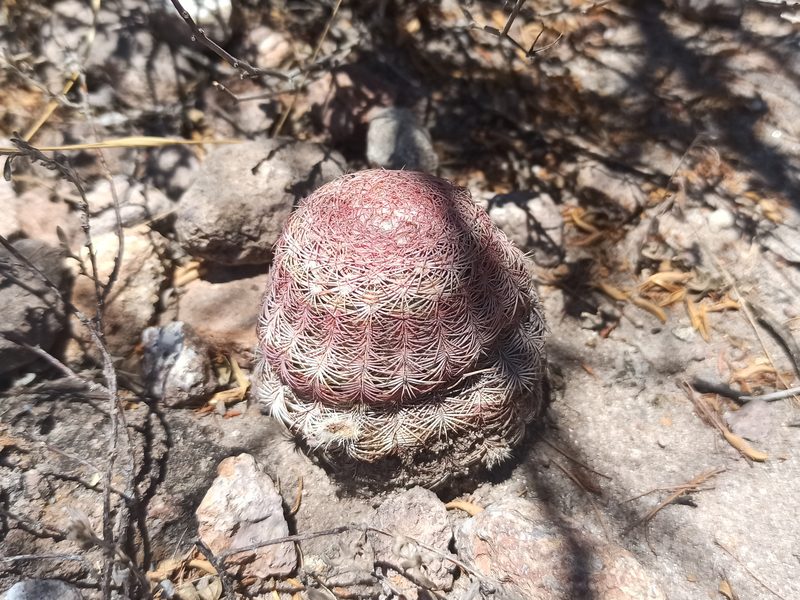
Echinocereus rigidissimus is a Sonoran borderlands species whose dense pectinate spines change colour with age. New growth at the apex emerges ruby red, fades through pink, and ages to near-white at the base of the stem. The result is a horizontal banding pattern around the body that earned the common name rainbow cactus. The most heavily collected form is subsp. rubispinus (POWO-accepted spelling, often seen as rubrispinus in trade after the basionym), endemic to the Sierra Oscura in western Chihuahua. Spine colour intensity is light-dependent: full sun in cultivation is essential to reproduce the display character.
Trace any specimen back to its wild origin in our Echinocereus field numbers reference.